Category Archives: On the cover

On the cover

The Return Of Big Oil (CNBC Interview)

The recent outperformance of the integrated oil sector has been quite amazing. It is one of the best performing sectors year-to-date.

The past five years have been disappointing for investors, as the sector underperformed due to weak growth, Return On Capital Employed falling from 28% in 2007 to 13% in 2013 and various mega project delays. Focusing back on profitability and sustainable growth is part of the re-rating process. Continue reading The Return Of Big Oil (CNBC Interview)

US: The Weakest Jobs Recovery On Record

02/05/2014

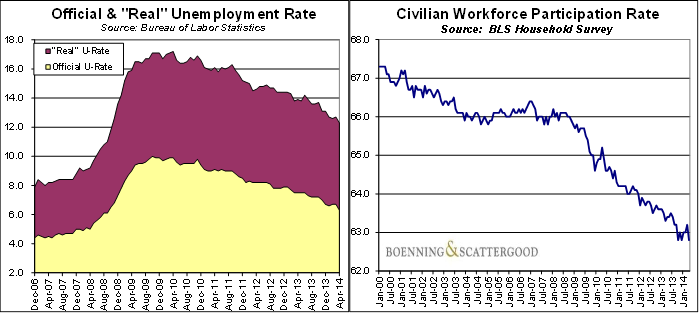
US unemployment rate is at 6.2%…. or is it?

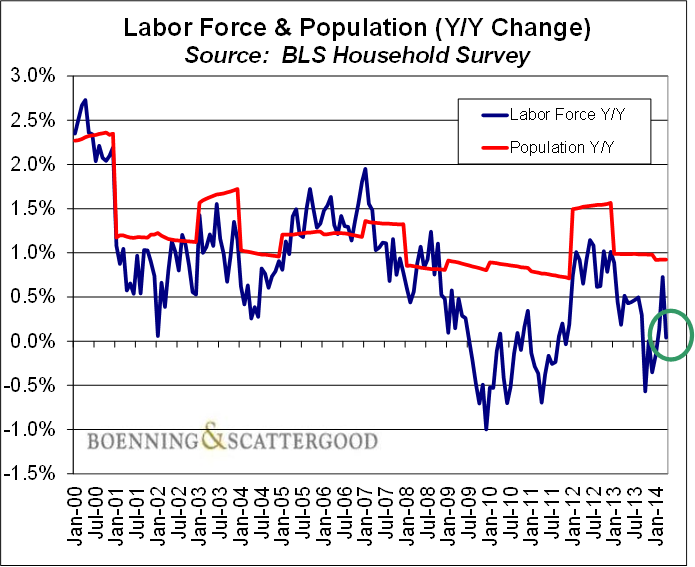
The US Labor Force plunged -806k to 155.421 million, up just +0.04% Y/Y (+0.73% Y/Y prior).

Most importantly, those Not in the Labor Force surged +988k to 92.018 million, which is the highest on record.

The Workforce Participation Rate fell to 62.81% in April (63.18% prior), the lowest since 1978.

The (U-6) “real” unemployment rate is 12.3%. (Source Boenning & Scattergood, US jobs data)

Additionally, according to the Bureau of Labor Statistics, 20% of all families in the United States do not have a single member that is employed.   62% of all Americans make $20 or less an hour at this point. The number of Americans receiving benefits from the federal government each month exceeds the number of full-time workers in the private sector by more than 60 million.


US fake unemployment


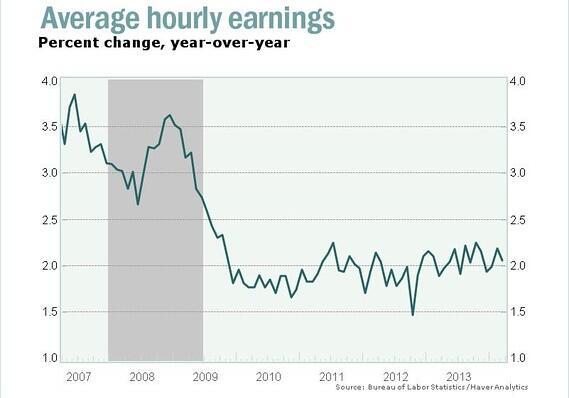
Nominal wage growth is also inexistent:


US wage growth


And no, the difference between unemployment and the decline of labour participation is not explained just by  “demographics” and retirements… at all:

Population participation


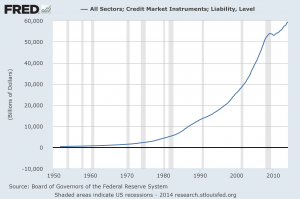
Meanwhile, debt reaches record level

Total-Debt-300x199

Interview On New Spanish Unemployment Data & Spanish Energy Sector

Listen here:

http://www.thespainreport.com/5960/interview-daniel-lacalle-new-spanish-unemployment-data-spanish-energy-sector/

(The following was published in El Confidencial on 29/4/2014)

On Tuesday,   the Spanish Labour Force Survey or the first quarter of 2014 was published. The official release of the Statistical Bureau (INE) states that “the total number of unemployed has fallen by 344,900 people in a year.”

The number of unemployed decreased by 2,300 people in the quarter and stands at 5,933,300.

Unfortunately, the job participation fell by 184,600 people, although the decline is the lowest in a first quarter since 2008 .

The few positive data show fragility and weakness . These are insufficient. Taxes have to be cut. Political spending needs to be cut. The country needs to stop hindering job creation.


Labour participation fell by 195,800 people in the private sector, and increased by 11,100 and the public sector. Increasing public employment with more debt is not creating jobs.  It enlarges the hole .

Taxes have to be cut. The fiscal effort in Spain remains one of the highest in the OECD. And it’s not a race to raise revenues, as I explained in the post ” Spending is the problem . ” The policy of sustaining GDP  with bloated spending  does not reduce unemployment. It’s urgent to cut taxes.

Spain has the potential to create millions of net jobs. It is expected that the country will create 650,000 new jobs between 2014 and 2015 – (I estimate about 800000 to 2016) – but it’s not enough.

Jobs will not come from a hypertrophied Administration that consumes nearly 45% of the country’s resources and where spending on public employment represents 11.9% of GDP, higher than the average of all the developed countries, which stands at 11.3%. Not to mention advisors (one billion euro per year) or employees of public companies.

Jobs are not going to come from large companies that already have an average of 20% more employees than its European peers (employees relative to turnover in the country, according to Bloomberg). Jobs will come from self-employment and SMEs.

To reduce unemployment Spain must:

–  Encourage self-employment . Create businesses in 24 hours, as in many countries, not being one of the OECD countries where it is more expensive and slower to start a company. The time required to start a business in Spain is twice the average of the OECD. Creators of small businesses and startups can not see that the cost is unaffordable relative to the risk assumed.

–  Encourage SMEs.  We should not forget that they are the ones that create 70% of the added value of the country. Lower corporate taxes and Social Contributions to create jobs. The Spanish companies spend a total of 58.6% of their profits to pay taxes, according to World Bank data.

–  Reduce self-employed fees.  Self employed tax contributions have increased by 20%. This has to change now.

–  Reduce taxes on businesses.  New companies should not pay social security contributions and taxes until they have two years of profits, as in the UK. And drastically curtail bureaucratic obstacles and the extreme complexity of a country’s legislative system with seventeen regimes creating hundreds of rules each year. Change incentives: less foremen to “stop and control” and more facilitators.

–  Reduce income tax to increase consumption.  Yes. Save.Without savings, and later with consumption, the economy does not kickstart. Discouraging savings to keep an inflated GDP is a wrong and dangerous policy. The gross salary of a worker deducts 47.3% in taxes. Adding VAT, 67.4% of an average salary goes to the state.

–  Cut political and superfluous spending, subsidies and bubble excesses , as I said in this  post . Spain has increased government spending by 48% between 2004 and 2009 and only slightly reduced by 5% since 2010.

The solutions will not come from the same wasteful policies and interventionism that destroyed 3,000,000 jobs.

The Official Survey data shows the obvious: Not enough jobs are being created with a hypertrophied state.  Data shows recovery but it is fragile and insufficient.  Much more can be done.

We must lower taxes, and now.


Important Disclaimer: All of Daniel Lacalle’s views expressed in his books and this blog are strictly personal and should not be taken as buy or sell recommendations

CO2 … recovery or dead cat bounce?

CO2 recovery

Carbon has seen a decent bounce after the collapse back to €5.80/mt (albeit nowhere close to the highs of €20/mt seen a few years ago). Carbon is trying to climb back after the recent sharp correction. I commented a few reasons for the fall in prices here.  Now to the recovery…

What is driving prices higher?

. Kickstart of the carbon backloading plan, which sets aside 900m carbon certificates on a temporary basis. Backloading is implemented in 2Q 2014 after a 3-month scrutiny period and lasts until 2016. However, the 900 m certificates will be re-injected in 2019-20 again, so the oversupply is not addressed unless we see massive increase in thermal demand, which is unlikely given oversupply in generation and renewables rollout. As UBS points out “9GW of new efficient coal plants with marginal cost not higher than €30/MWh will enter the system by 2015, with a negative effect on dark spreads. In combination with declining power demand and renewables capacity growth (5 GW), we see little reason for a bullish view on generators”.

Market is very oversupplied, but the implementation of backloading has already started. So what we are seeing is a liquidity driven squeeze, not a fundamental shift in supply-demand. The most optimistic scenarios from analyst estimates see oversupply lasting until 2030 (UBS sees 2032).

Oversupply of EUAs has gone from 500 million metric tonnes in 2010 to 900 million metric tonnes in 2014 and despite backloading it is expected to double by 2020.

Mr Bostjan Bandelj a director at Belektron in Ljubljana said on Reuters that “Even as backloading seems a done deal, prices are under pressure from government auctions and sales of allowances from a special reserve by the European Investment Bank in the next months.”