Category Archives: Sin categoría

Thoughts On The European Crisis

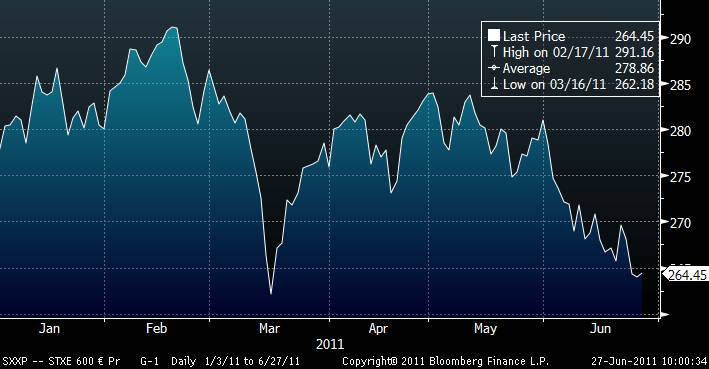
EUROSTOXX (1)

(Extract from an interview with me published in the Spanish press on June 20th, 2011)

How do you see the situation in Europe?

Complicated. On the one hand, Europe has a powerful engine, Germany and the Nordic countries, and sometimes we forget that this engine has the same GDP as China.However, industrial demand from the rest of Europe is deteriorating, and countries have not used the crisis to reduce debt dramatically.

A strong euro, driven by the European engine does not help, and differences between countries have increased. A strong euro means that the over-indebted economies, which are also big exporters, become less competitive.

In my opinion, the estimates of GDP, especially for 2012, are still very high and the estimated deficit levels are relatively optimistic in the peripheral countries. Italy could be a negative surprise, but this crisis can also be a great opportunity to eliminate the weight of the low productivity and high debt  sectors (construction, civil works) and support high-productivity sectors (technology, energy, services) that have been behaving really well under the circumstances.

What can happen if finally Greece has to restructure its debt?

So far the European crisis has been suffered by citizens, equity investors and businesses, but not by the bondholders. This paradox is curious. Europe has an entire economic and financial system that is supported by the fallacy that sovereign debt has no risk. This affects everyone from private investors to governments (local and state) to banks, their investment criteria and their perception of risk, and has generated a disproportionate percentage of sovereign bonds in portfolios. The CDS widening has been perceived as an opportunity to buy “no-risk assets but with high return”, not as a warning sign.

Going back to the Greek debt, to keep bonds as if nothing was happening, when these are already discounting a “default”, only prolongs the agony of a story whose end can only be to restructure. Once the debt is restructured in a proper way, it will be the time to see the beginning of the recovery in Europe and the peripheral countries. It will likely be a tough process and austerity plans will be much more demanding than current estimates, but it will also be the beginning of the solution, because the new governments that will manage Europe between 2013-2015 will no longer have the same vision of the problem of debt which so far has been to “hold on and wait for the issue to solve itself.”.

If it were in your hand … bail-out or restructuring?

Restructuring always, in an orderly manner and agreed with the financial institutions. Bailouts only encourage bad government behaviour , because there is no penalty for poor managers. Citizens end up paying anyway through higher taxes and worse working conditions because, as we have seen with Greece, that received a massive bailout already two years ago, a few months later the economy is in the same same poor situation, if not worse.

And Spain, is it better than the market thinks or, as some say, the situation is worse?

The big question is the debt of the regional communities and the State’s ability to join community after community to solve the debt problem and tackle unnecessary spending. Investors do not know exactly what the real indebtedness of the state is, and how much of all the enormous “receivable” items are simply bad debt and will never be paid.

Spain today is a bit better than the market thinks, and has positively surprised, because high productivity sectors of the economy have pushed in a very difficult environment, but that process can slow down or stop short if the real debt of the country is much higher, and deeper and more drastic reforms are not implemented because of a period of prolonged political uncertainty, because investment will stop.

What will we see in the markets short term?

The market discounts a very optimistic scenario for corporate earnings in Europe for the following two years, and especially a scenario of extremely optimistic cash-flow generation. EPS momentum is very weak. Consensus should review not only their earnings estimates, but target prices, because in some cases the latter ones are simply amazing.

A market correction that lowers the real PE (the revised one, not the current one) of the market to more reasonable levels will be a very attractive opportunity to buy, considering that the next cycle will probably be longer in duration (if countries do the right thing about debt) and less aggressive than the 2009-2010 one. The mistake, in my opinion is to seek refuge in index heavy weights or betting on companies that pay optical high dividends, when those are financed with debt.

Given that interest rates will not be low forever, it still makes sense to stick to well-capitalized stocks, growth companies that generate superior returns in the bottom of the cycle, and focus on high-productivity sectors.

External link: http://www.cotizalia.com/galeria/daniel-lacalle-20110620.html
Why CO2 collapsed 20% in two days

CO2

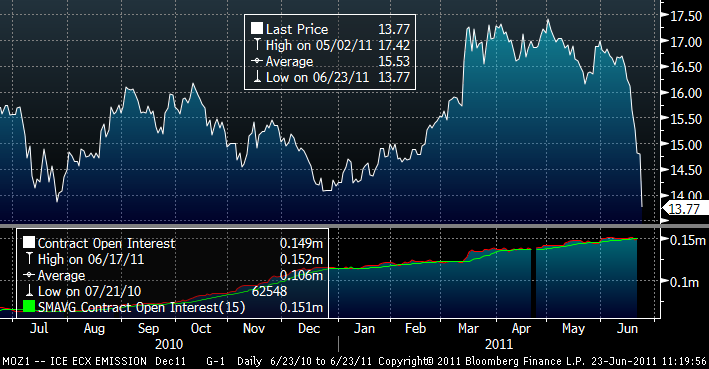
The price of CO2 emission rights in Europe has fallen 20% in two days. The move is the most drastic seen in the commodity space in a long while and can be attributed to the following dynamics:

a) Financial investors went long CO2 rights buying into the catalyst of the phase III of Kyoto, the stronger policies towards renewables announced by the EU and the infamous “Fukushima effect” (buying into renewable themes on a vague promise of policy changes and the German nuclear phase out).

b) At the same time, European industries, which were already long EUAs in 2009 and 2010, see less need to hedge because industrial demand is poor and there is excess supply.

The EU decision to make an early sale of 300mn allowances from a post-2012 reserve is also weighing down on prices.

Poland recently vetoed the proposal to toughen EU’s emission reduction program, which is also adding pressure on the price.

Also, Greece’s decision to auction off  their EUA reserves to raise funds for the government had a bad start last week, as the first auction on Wednesday saw only 4% of the available credits sold at €16.11/t. They are still selling. Panic can be partially explained also by the concern that, if Greece sells all its EUAs, what if Belgium, Portugal or others do the same?

c) Lower demand. Deutsche Bank has cut its 2011 forecast of CO2 price by 19% to €17/t and 2012 estimate by 14% to €19/t, largely driven by expectations of slower economic growth in Europe…

d) … Creating the perfect storm. When CO2 prices broke the support level of €15.5/t, we saw large stop losses because of the previously mentioned large options positions… and the stop-loss forced selling added to the governments selling and lack of demand has generated this slump.

At the core of the problem we have the issue that Europe’s debt crisis affects CO2 markets the most because the European Union is 30% of the emissions of the world, but (hold on) 100% of the cost as no other country has adhered to emission trading schemes. Therefore, a slowdown in industrial production and a debt crisis that could delay the extremely aggressive and optimistic plans for a low carbon economy announced for 2050, added to the slow but sure slowdown in power demand is proving that a system that was artificially created (see my comment here) is causing the demise of a government-forced scheme that ultimately was only a tax, as emissions actually rose in 2010 despite all the good intentions.

As a very knowledgeable friend of mine says: “Investing in renewable themes right now is risky because everything is a donation”.

Further read:
http://energyandmoney.blogspot.com/2011/01/some-energy-thoughts-for-2011.html

http://energyandmoney.blogspot.com/2009/10/careful-with-german-power-prices.html

http://energyandmoney.blogspot.com/2009/05/reserve-margins-are-clearly-acceptable.html

Can Norway Really Offset Oil Production Decline?

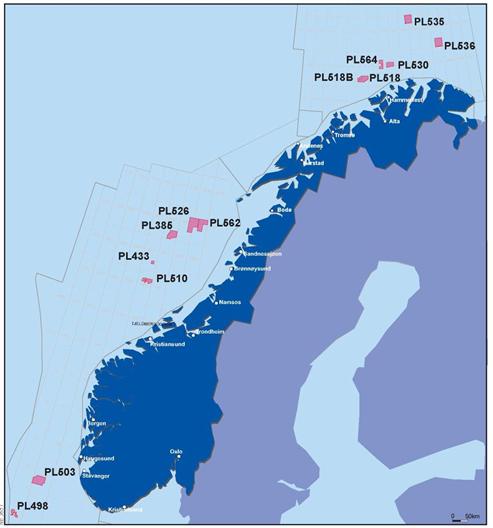
Nrwegian continental shelf

The Norwegian oil production decline is staggering. The figures are simply incredible. Total liquids production in April came at 2.10mbpd, flat from March, but down 7.1% year-on-year. Production has fallen by more than 20% (440kbpd) from 1991 levels, Problems have come in all shapes and forms. Corrosion of old infrastructures, lack of proper investments prior to the merger of Statoil and Norsk Hydro, lack of in-depth analysis of reservoir and the optimal recovery techniques, added to a less than stellar appraisal and development process.

Let’s start with a fact: There is a technical and cost challenge that is evident, but given the success in exploration and the experience of similar geological structures, it is not clear that the decline is impossible to offset due to an irreversible geological problem.

Statoil has set itself to correct this issue and has in the pipeline more than 100 projects targeting 1.2mbpd. Will they be able to offset decline?.  Well, the track-record so far does not lead me to be optimistic. Since 2004 Statoil has been a story of consensus downgrades (it was supposed to deliver 16% production growth in 2006 and it ended being flat), cost overruns and delays. True, the merger with Norsk Hydro did not make things easy, but the under-delivery was simply jaw-dropping. Now things are set to change.

Statoil, at its Capital markets Day in New York, set itself with the ambitious target of growing production by 3%pa to 2020. The problem is that the road will be bumpy. 2012 growth will be strong, only to be flat in 2013 again, and project delivery gets trickier as we move into the back-end of their target period.

Capital intensity to deliver this offset of decline and subsequent growth will not be small. $16bn per annum and $90/bbl break-even (remember taxes are very high in Norway) until 2015, when the growth projects finally kick in and costs could, if delivered, start to fall.

From an investor perspective, and from a global-supply demand standpoint, the most relevant point is that Statoil intends to keep production flat as a base case from 2011-2020 implying an absolutely categorical view that  decline will be offset. Skrugard, which could add 60-90kbd (gross) by 2020, or a Train 2 at Snoehvit could be the main surprises. Also, new “fast-tracked” projects beyond the existing 10 fast-tracked projects – could add another c.70kbd by 2020.

What can go wrong? First, such a large number of relevant but complex projects can be delayed easily. Skarv has already been delayed, resulting in a 20kbd impact at the project level in 2011.

Although average breakeven for Norwegian Continental Shelf projects stands at c$50/bbl, there are also significantly higher cost projects. Costs per barrel have escalated with the production decline, but once the main technical challenges have been well understood, the infrastructure has already been in place and can be used for multiple projects, costs can rapidly fall. Now it’s time to deliver. It will not be easy.

Further read:

http://energyandmoney.blogspot.com/2011/01/some-energy-thoughts-for-2011.html

http://energyandmoney.blogspot.com/2009/11/2010-warning-risk-for-non-opec-supply.html

Shale Gas, Poland… The Energy Treasure That Most Of Europe Rejects

poland shale(This is a merger of two articles I published in Spanish in Cotizalia)Nine hundred billion euros.This is what Europe could save in its goal of reducing CO2 emissions by 80% in 2050 if, in addition to further renewable energy, the continent would develop its shale gas reserves according to this sector study. And what will Europe do? If it follows the example of France, threaten to ban hydraulic fracking.

The funniest thing is that the coal, conventional gas and solar lobbies have all joined forces in the war against shale gas. There must be something truly threatening and interesting to see such an unholy alliance.

None of the three are interested in cheap gas prices, because they have seen with horror how gas prices in the U.S. have plummeted due to the shale gas revolution, and therefore obliterated the use of coal for power generation and the grants of succulent subsidies as abundant energy reduced power prices (see my previous post about this). And for a continent obsessed on energy independence, it seems funny for Europe to deny the chance of developing domestic gas, not Russian or Nigerian or Qatari. European. And 50% cheaper if production grows as it has in the United States. What a horror. Ban It!

Europe has no fewer than 156 tcm (trillion cubic metres) of estimated shale gas reserves. That means c90 years of demand covered and saving up to €24bn p.a of subsidies for alternative technologies. Ban it!.

Fracking technology, thanks to the revolution of shale gas in the United States is tried, tested and of negligible ecological impact. However, we have seen many alarmist reports, even a movie, Gasland, which was immediately refuted by the industry, scientists and the Department of State U.S. Energy as inaccurate… But best of all in these alarmist reports is that in every one you read that “we could not confirm accurately any of (these) claims “(Cornell study, for example). When I wrote this post about the shale gas revolution many just ignored it as uneconomical.

Point by point, it is worth noting:

Hydraulic fracturing technology is proven, is used in thousands of wells in the U.S. annually safely, and there have only been one or two cases of minor accidents. The fluids used in the fracking of the rock are composed by more than 99.98% of water (94.62%) and sand (5.24%), with a minimal amount of chemicals, highly diluted, easily stored and handled safely.

Of these chemicals, the majority (hydrochloric acid, ethanol, methanol, ethylene and sodium hydroxide) are recovered perfectly in the extraction process.No state or local department in the U.S. has found evidence of water pollution of aquifers. The industry is also using more than 5,000 tons of steel and cement to protect the groundwater, and the fracking process occurs at least a mile deep, well away from the aquifers.

This reality, Europe’s available natural resources is what none of the politicians and lobbyists mentioned, fans of subsidies, want you to see. They prefer inculcating fear with tales of energy dependence and expensive subsidised technologies. Before looking for a solution to develop the continent’s natural resources efficiently, in a clean and competitive manner, they prefer to ban. And then complain about the energy dependence.

Europe wants cheap energy, but does not want nuclear, and now seems unwilling to develop shale gas. Meanwhile, in the 1st quarter of 2011 energy costs, paid by businesses and consumers, are again the highest in the OECD. The EU will continue to be 100% of the cost of CO2, 70% of energy subsidies in the OECD and will further reduce its ability to compete.

While gas production in the U.S. has pushed prices for gas and electricity at highly attractive levels for industrial productivity, the policy of “not in my backyard” of the EU continues. It’s easy to complain about the evil energy exporting countries when at the same time domestic production is curtailed. Instead of collaborating with the industry and with proper regulation to monitor that gas is extracted in the safest and most ecological way, they prefer to ban, with the risk of sinking the competitiveness of our economies with expensive energy as we demand that the rest of the world changes.

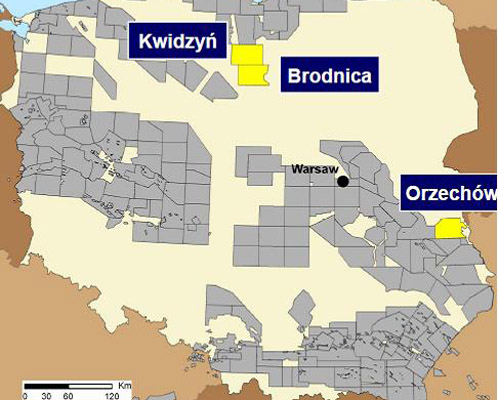
But Poland is different. Wood MacKenzie estimates that Poland could hold 3 trillion cubic feet of gas reserves in unconventional (tight gas and shale) spread between the North and the Midwest,which, if confirmed, would mean an increase in European gas reserves of 47%.

Poland depends on Russian imports by more than 75% (11.6 BCM / year) and the unconventional gas reserves can be a very important factor to improve its ratio of domestic production.

Given an opportunity to access new reserves in countries with no geopolitical risk, European companies are starting to wake up and rushing to the challenge. Total has just moved in. However, in Poland the main companies betting on the resource base are Chevron, ExxonMobil, Marathon, Talisman and Conoco.

The Polish government has awarded over 85 exploration licenses lately with the goal of achieving results in three to four years. Conoco (with 3 Legs) has been the first to drill near Gdansk, and the results are very solid although it is early to know the cost structure or plan development.

Besides the major U.S. oil companies in Poland there are several independent exploration companies present, 3 Legs, San Leon or Aurelian, for example.

Poland’s shale gas opportunity shows the following key points, according to Tudor Pickering:

  1. Geologically thick, organic, brittle, with multiple targets at <10,000 ft.
  2. EIA ranks the Baltic Basin as 80% play success factor.
  3. Thermal maturity indicates abundant gas generally, but oil windows are possible.
  4. Lifting costs in Poland may be a quarter of the US.
  5. Political and public support is very high.
  6. Seismic is being acquired and 30+vertical wells are being planned for 2011-12.
  7. Low royalty and corporate tax at 19%.
  8. Poland gas price is more attractive than US Henry hub as it is oil linked, and priced at $8-8.5/MMbtu (versus US at $5/MMBtu).

The recent IPO by 3legs values the Baltic Basin shale acreage at ~$450/acre.

It is worth alerting the risks of being overly optimistic.That’s why it seems very exaggerated what seeking Alpha said that Poland shale gas may be the end of Gazprom.

Poland has signed an agreement with Gazprom to increase its supplies by 30% in 2011 and Ukraine has increased its commitment to buy Russian gas by 11% this year …And Ukraine has its own potential in shale gas exploration, as Chevron knows. that is why the US giant is reviewing prospects in the Polish border with Ukraine, in Zamosc.

And in the rest of Europe? It is still very difficult to see real possibilities due to lack of political support. Statoil and Chesapeake are analysing more than 15 new areas in Germany, France and the North Sea, among others. The last time I saw the CEO of Chesapeake in March he was confident of the geology but not optimistic about political support.

In my opinion, the shale gas in Europe is an excellent opportunity but also carries an operating cost of not less than $2/mmbtu given the enormous cost of water in Europe, representing nearly 60% of the cost of drilling. and water is essential to fracture the rock.

Poland is now beyond the stage of “promise” and is a country we will follow closely in this blog, because when you see such concentration of oil companies in one area, there is a reason.

Further read:

http://www.thegwpf.org/press-releases/2938-new-report-shale-gas-shock-challenges-climate-and-energy-policies.html

World shale resources:

http://www.aei.org/article/103815

http://energyandmoney.blogspot.com/2010/01/revolution-of-shale-gas.html

http://energyandmoney.blogspot.com/2010/11/shale-oil-600-years-of-supply.html

http://energyandmoney.blogspot.com/2009/11/china-exxon-and-war-for-resources.html