Chinese Imports discrepancy impacts commodities

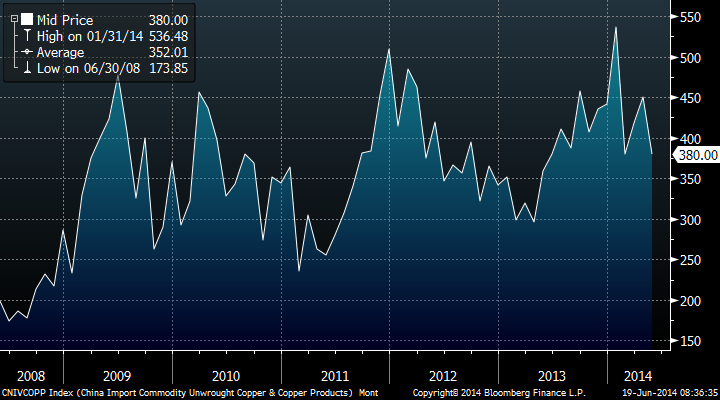
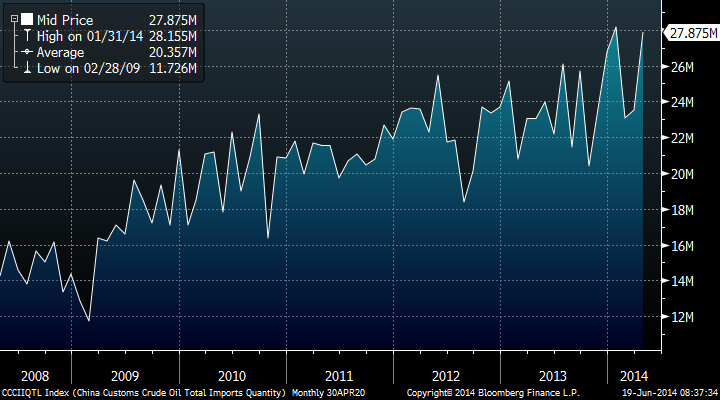
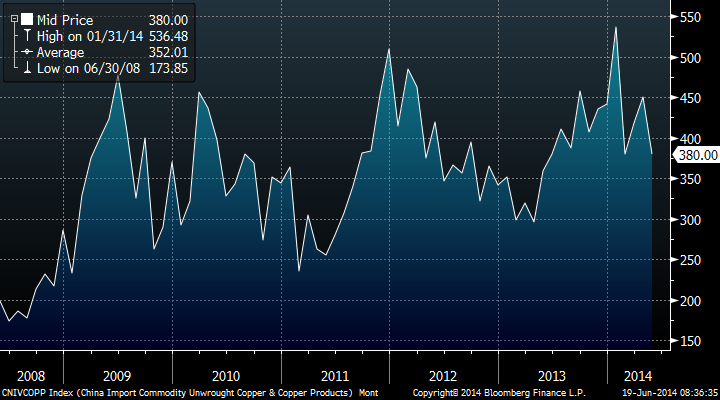
The discrepancy between Chinese imports continues to drive commodities. As seen below, Chinese copper and coal imports remain weak and trending down while oil imports are rising (see graphs below). Copper is down 1.8% MTD and 9.2% YTD, maybe as a vengeance against Chile for obliterating Spain mercilessly in the World Cup.

chinese copper imports

Oil continues to strengthen with Brent  at $114.074/bbl and WTI at $106.51/bbl despite yesterday’s bearish DOE data. Crude drew 0.58 m Bbls vs. expectations for a 0.58 m Bbl draw. Cushing crude inventories built 0.25 m Bbls on the week and now stand at 21.4 m Bbls.  Gasoline built 0.79 m Bbls vs. expectations for a 0.39 m Bbl draw and distillates built 0.44 m Bbls vs. expectations for a 0.04 m Bbl draw. All products drew 0.35 m Bbls. Refinery utilization was down 0.8% vs. expectations for a 0.7% increase. Refinery utilization stands at 87.1% vs. a 5-year average of 88.2%.

Iraq update: The head of Iraq’s state-run South Oil Company Dhiya Jaffar said on Wednesday that Exxon has carried out a “major evacuation” of their staff and BP had evacuated 20% of its staff. He said ENI, Schlumberger, Weatherford, and Baker Hughes had no plans to evacuate staff from Iraq following the lightning advance of Sunni militants through the country. (Reuters) Comments that the refinery in Baiji had fallen to attackers from the Islamic State in Iraq and Syria have been denied by the Malaki government.

Chinese oil imports have strengthened, driving the products market tighter and Tapis to $118.16/bbl, a premium over Brent.

chinese oil imports

Coal continues to weaken to $79.80/mt driven by weak Chinese imports (see graph below).

chinese coal imports

US gas remains well supported at $4.56/mmbtu. Consensus estimates a 112-Bcf inventory build this week vs. a build of 107-Bcf last week and a build of 91-Bcf last year at this time. Gas demand likely has decreased by 1.8-Bcf/d w/w, mainly driven by a 1.6-Bcf/d drop in power sector consumption.

UK gas continues to weaken, at 40 p/th, down 3.97% this month despite the Ukraine crisis, as Gazprom has reassured European markets will continue to be well supplied, Statoil has promised to increase exports if needed and inventories remain in the upper level of the 5 year average. Recent weak gas production from Norway (down 9% year on year) shows that Europe has not needed to increase its imports and demand remains weak.

Spanish power prices rise 89bps driven by low hydro production and extremely hot weather. Spanish power prices are the best performers this year of all continental power prices, with France down 5.86% YTD, Germany down 5.6% YTD, Nordpool down 9.6%, UK down 16.9% and Spain only down 1.2%


Important Disclaimer: All of Daniel Lacalle’s views expressed in his books and this blog are strictly personal and should not be taken as buy or sell recommendations
World Trade Slows Down

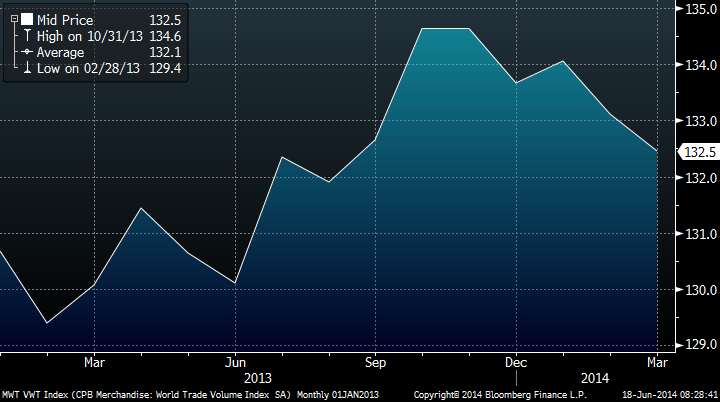
comercio mundial


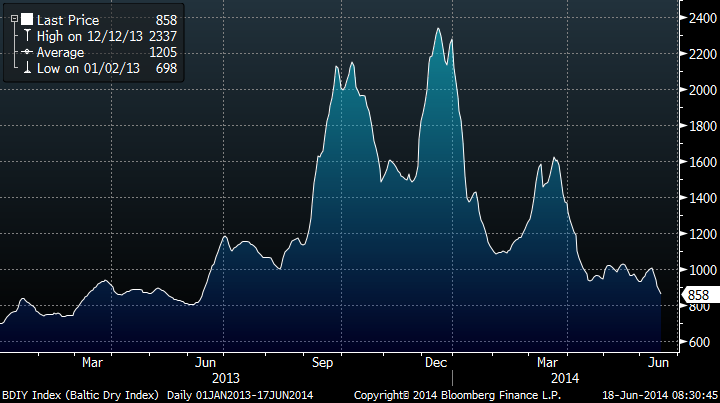
Worth noting today the evident slowdown in global trade, massively revised down (30%) from January estimates. Japan posted a 2.7% decline in exports in May, UK was also down 5% in April and Eurozone exports stalled… but at the same time the Baltic Dry Index is down 2.58%v this month (-52.3% this year) driven by ongoing weakness in Chinese overall imports. Overcapacity paints part of the picture, but the other most relevant part is weak trade data, well below the +16% increase expected in January (see graphs below). Merrill Lynch is betting on a BDI rebound helped by seasonality, re-stocking and a rise in seaborne iron ore volumes of +16% in 2014 and +10% in 2015. I fail to be that positive, as the indications from industrial production globally are negative regarding marginal additional growth expectations, as revisions are down 12% from January estimates globally and the backwardation on coal and iron ore has steepened.

If GDP forecasts are correct, the World Trade Organization expects a broad-based but modest upturn in the volume of world trade in 2014 (+4.7%), and further consolidation of this growth in 2015 (+5.3%).

The average ratio of trade growth compared to GDP since the mid-1980s is around 2 to 1 – with trade growing at twice the pace of GDP, according to the WTO. However, in the last two years the ratio was closer to 1 to 1.

To deliver on the expected +4.7% trade growth in 2014, this ratio would have to move to 2.5 to 1 from June to December assuming that global GDP growth expectations are correct (+3.3%)

BDI May

Freight rates for panamax dry bulk vessels are now below opex, and long-term forward rates have fallen below break-even. The main reason for this weakness is in the coal market.

Chinese coal import is the most important trade for panamaxes and chinese imports of thermal coal are expected to be lower in 2014 than in 2013.

Capesize rates have come down 43% YTD and forward rates for Q4 fell 4% this Friday.

Adding to this a 100 milion tonnes of Australian capacity growth, the outlook for both coal prices and the Baltic Dry is not positive. Freight companies are growing the fleet by 4% this year so oversupply is even higher.

Brent at $113.58/bbl, and WTI at $106.87/bbl. The Norwegian Petroleum Directorate has issued its production numbers for May (this aggregates all Norwegian production each month). Oil is down 13% yoy and gas is down 9% yoy.

Worries about disruption to Iraq supply continue to support prices. The IEA in its medium term oil market report published yesterday cut its Iraqi supply forecast by close to 0.5m b/d & now expects it to reach only 4.5m bpd in 2019, commenting that the growth is “increasingly at risk” (this compares to the government’s target of 8.5-9m bpd by 2020).

Coal continues to weaken to $79.45/mt helped by lower Chinese imports and higher Australian exports. Chinese iron ore import prices are down 33.5% YTD.

CO2  at €5.80/mt still driven by backloading. Impact on power prices is inexistent. CO2 is up 13.4% this month and power prices are flat all over Europe.

UK gas is down 1.34% at 40.45p/th with all the gains of the Ukraine crisis erased from the price yet again. Both Europe and Ukraine have ample inventories and alternative supplies to offset disruptions. UK gas is down 40.7% YTD. UK power prices are down 12% YTD due to the weak gas price and poor demand.


Important Disclaimer: All of Daniel Lacalle’s views expressed in his books and this blog are strictly personal and should not be taken as buy or sell recommendations
Iraq and Ukraine move the commodities market

Geopolitical black swans are impacting commodities this morning, with Iraq conflict worsening and Russia threat of cutting supplies to Ukraine.

Brent is at $113.02/bbl and WTI at $107.32/bbl driven by concerns about Iraq. Markets are reacting well as the physical market is not affected so far but concerns are justified.

Iraq produces 3.5mbpd, or 4% of global production and is seen as a key source of future supply growth. Production is mostly in the fields in the South, so far unaffected by the latest attacks, concentrated in the North, according to JP Morgan.

So far the physical market has not seen a relevant disruption, but markets will remain nervous as long as Malaki continues to lose the grip of the key cities, and the terrorists get close to Baghdad.  Expect oil to move closer to $115/bbl Brent as the market analyses the risk of losing exportable production.

The Islamic State in Iraq and the Levant (ISIL) have seized the city of Tal Afar in Northwestern Iraq yesterday but have not continued to advance to Baghdad, so far only concentrating on northern Iraq. The rebels have control of Mosul, the second largest city in Iraq, along with Tikrit and the small towns of Dhiluiya and Yathrib, north of Baghdad. Iraq’s military spokesman Qassim Ata yesterday said that the Iraq army had killed more than 279 members of the rebel group. President Obama has indicated that he is reviewing military options to help Iraq in fighting the rebel groups.

Kurdistan PM is mentioning in the BBC the possibility of splitting Iraq into three separate regions.

The Kurdistan Regional Government has taken over security of the giant Kirkuk field (260k b/d of production) in the North Remaining oil production in the northern oil fields is another 435k b/d. Iraq has the 5th largest proven oil reserves & is the 2nd largest crude producer in OPEC, behind Saudi Arabia, at 3.5 mbpd. OECD oil inventories were 2,624mb at end April, 77mb lower than the 5-yr average & 53mb lower than last year.

My thoughts:

– The US is unable to get involved in a war. The fact that the US will likely be oil independent (including Canada) in 2016 gives little incentive to take action.

– There is very little real western support for Malaki and the country is currently too corrupt so there is risk of a bad public image and lack of popular support problem.

– Oil companies in the South have very strong armies and security is very tight. I see low risk of oil supply disruptions and the ports are working adequately.

– The three large oil companies must have anticipated these issues as they shipped most of their needed equipment last year. They also doubled security.

– Low probability of the ISIS reaching Baghdad but strong probability of a country that ends up broken in three (Kurdistan, a Sunni North capital Tikrit and a Shiia South capital Baghdad).

Helping reduce the geopolitical risk on oil is the FT reporting that US liquids production hit 11.27 mbpd in April, and is today above its previous peak in 1970 of 11.3 mbpd. With a higher percentage of NGLs, still crude production was 8.3 mbpd in April (now 8.5m), lower than the record high of 10 mbpd in November 1970.

UK gas rises +7.1% at 45p/therm and European gas seems to rise in sympathy as Gazprom threatens to cut supply to Ukraine after the deadline to pay the outstanding bill of $2bn passed with no agreement on  a timetable of payment or price. The Ukraine government is mentioning that the price has to be revised to international levels and that they cannot pay this figure or the revised price of $8.5/mmbtu. The EU is looking for an option that includes a revision of the price for a long term contract and gradual payments. Gazprom will cut off supplies unless Ukraine pays for the gas up front.

Gazprom however, will not disrupt supplies to Europe. 33% of Europe’s gas comes from Gazprom and 50% of it is transported through Ukraine. Ukraine has enough gas in storage (13bcm) to hold on to summer demand as its annual consumption is 33bcm according to UBS. Europe also has a record amount of gas in storage after a very warm winter.

Europe’s largest gas supplier after Gazprom is Statoil who mentions it can “easily” offset any short-term disruption of Russian supply.

 Coal remains weak at $80.40/mt holding on to its support level despite news that freight rates for panamax dry bulk vessels are now below opex, and long-term forward rates have fallen below break-even. Chinese coal import is the most important trade for panamaxes and chinese imports of thermal coal are expected to be lower in 2014 than in 2013. Capesize rates have come down 43% YTD and forward rates for Q4 fell 4% this Friday.Adding to this a 100 milion tonnes of Australian capacity growth, the outlook for both coal prices and the Baltic Dry is not positive. Freight companies are growing the fleet by 4% this year so oversupply is even higher.

The Baltic Dry index is down 3% this month (-60% YTD) driven by oversupply of reights and weakening Chinese imports.

 CO2 rises 53bps at €5.74/mt helped by backloading efforts to reduce the impact on CO2 prices of lower industrial demand and poor thermal output.

US gas rises 65bps at $4.67/mmbtu helped by the past six weeks injection data. It would require a very aggressive change in injection data in the next months to justify prices below $4/mmbtu… I believe we are going to see $5/mmbtu sooner rather than later. Weekly natural gas storage injection of 107 Bcf way below the consensus median injection estimate of 112 Bcf and the bears’ view of 161bcf. Total working storage is now at 1,606 Bcf, 727 Bcf below last year’s level and 877 Bcf below the 5-year average of 2,483 Bcf.

Power prices in Europe are reacting mildly… Germany at €34.70/mwh (-5.35% YTD), Nordpool at €30.78/mwh (-4% YTD). Spanish power prices are down 1.2% YTD and French -5.5% YTD.


Important Disclaimer: All of Daniel Lacalle’s views expressed in his books and this blog are strictly personal and should not be taken as buy or sell recommendations
European Elections show less change than feared


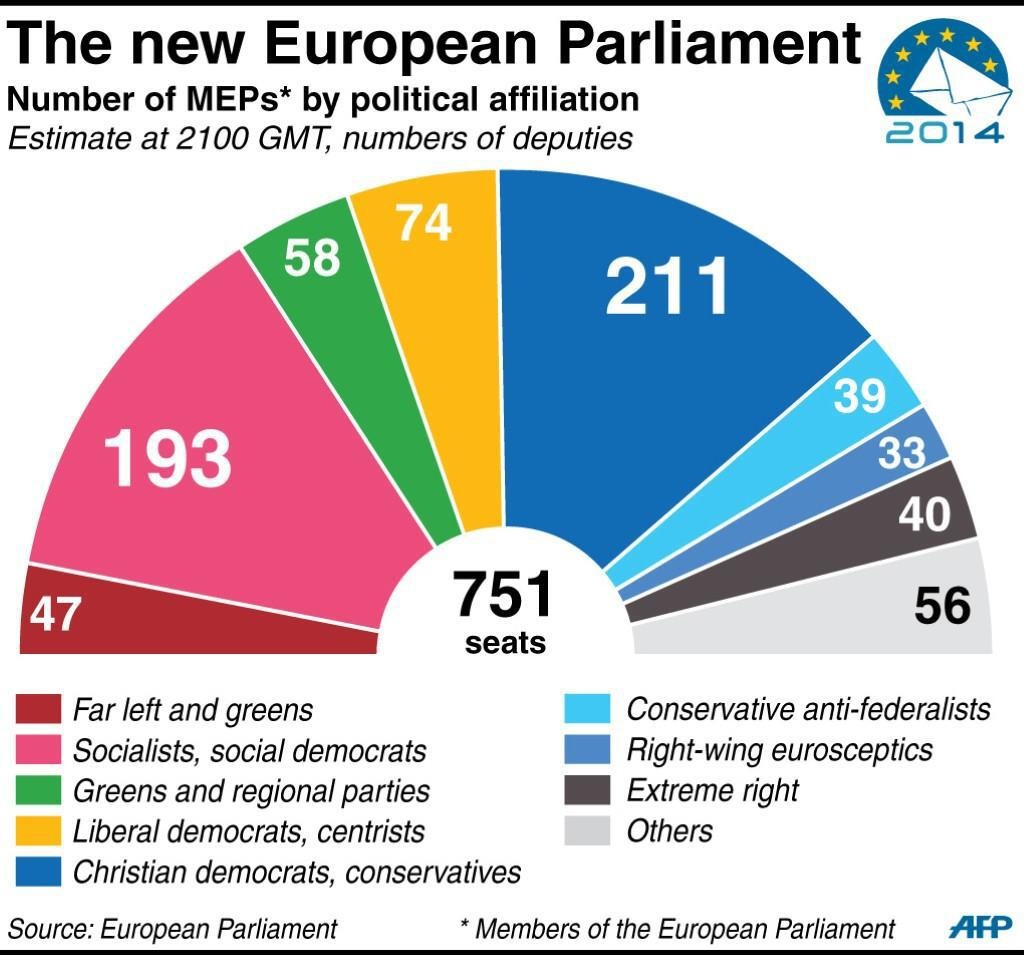
Despite the headline concerns about the rise of radical parties like France´s National Front, Syriza, New Dawn and the Danish Popular Party, in the elections 172 million people voted and less than 7.5% are votes for parties who are remotely in favour of breaking-up the Euro. If we take out the UKIP impact in the UK, as the country is not in the Euro, the “anti-single-currency” vote was insignificant, especially when we look at the political manifestos of parties such as France´s National Front, with a loose message of exiting the Euro “gradually”. 

Credit Suisse wrote this morning a nice report called “Europe beats Eurosceptics 6-4”.

As such, the EUR/USD opened this morning slightly up, and equity indices throughout Europe followed in unison, while peripheral Europe bond yields opened flat or marginally higher.  

The bipartisan nature of the European parliament has not been changed dramatically either. Juncker and the European Popular Party won (212 seats) but Schulz and the Socialists (187 seats) can try to set up coalitions. The possibility of a grand coalition is not small at all.

Eurosceptic parties won in three countries: France, Denmark and the UK (as expected, and with no impact on currency or policy), but lost massively in Italy (where Renzi won a landslide 40%), Holland and Germany. In Greece, Syriza won by a narrow margin, not enough to de-stabilize the current coalition.

Only two countries saw the current government win the elections: Germany and Spain, despite major losses in support in the case of Spain (PP lost 8 seats). The debacle of major parties did not change the landscape massively.

UKIP´s extraordinary victory (27.5%) is likely to make Tories take a more aggressive stance towards the EU and move forward with the referendum on the EU.

Bond yields likely to see limited pressure from the process of electing President and the press headlines regarding radical votes.

France seen as the biggest worry followed by Greece. Radical stop of reforms or, even worse, increasing government spending could trigger new concerns about deficits, debt and widening the imbalances of the economies.

The latest batch of rating agency upgrades in Spain and Greece, added to the exit of the bailout programs for Portugal, Ireland and Greece maintain the gradual recovery on track. Meanwhile, current account surplus in the Eurozone remains a key driver of improvement, added to the reduction of deficits and modest growth. All very fragile, but pointing in the right direction.

Once the elections have passed, this clears the path for a possible EU Quantitative Easing programme aimed at SMEs and corporate, even if there are strong challenges as we mentioned in this website (“The Difficulties of Implementing QE in Europe“).


EU parliament


Important Disclaimer: All of Daniel Lacalle’s views expressed in his books and this blog are strictly personal and should not be taken as buy or sell recommendations