The Greek Drama

(This article was published in Cotizalia on February 2012 and updated on June 17 for the elections)The exit of Greece from the euro and another default seems almost a certainty. An exit and yet another default.

Putting hundreds of billions into a state that consumes every bailout without tackling the issues of corruption and excess spend, when everyone discounts the inevitable, is a futile exercise and a collective suicide of the European Union. And bailouts have no positive effect on peripheral risk, which is still at levels that were considered “unacceptable” two years ago, despite unlimited liquidity injections.

The Greek state, which has more public workers than Spain with four times fewer inhabitants, has wasted bailout after bailout and continues to delay reforms, and now threatens to melt into a political debacle, with some parties asking to re-negotiate the treaty… After receiving the money.

I recommend you read the chapter on Greece from “Boomerang “by Michael Lewis to understand why the money that has been lent will not be recovered easily. But first and foremost, keeping this painful endless drama has no positive effect for Greece. It only helps, delays the pain actually, to the lending banks, especially German and French, which accumulate €138 billion of Greek debt.

No wonder that France and Germany, who keep €57 and €34 billion of Greek debt respectively, are those who insist on keeping the terminally ill in the euro at all costs, although the country’s GDP collapses at an annual rate of 4-6%, and debt to GDP is at 130%.

Rescuing Greece does not solve anything in a country that overspends 8% of its entire GDP every year, while revenues collapse and new expenditures appear every quarter. A bottomless pit in a system, the euro, within which it can not and will not recover.

And the difference between Greece and other European countries, like Portugal, is that its political parties are not accepting to make the needed reforms. The whole system is becoming almost a swindle of promised reforms in exchange for a bailout that never reaches the population (80% of the bailout money returns to the banks to pay interests) but the people do suffer the budget cuts, which happen everywhere except where they are needed (in the bloated political and public system).Rescuing Greece does not work, we have seen it many times. But would it really be a debacle if Europe allows Greece to restructure and exit the euro, staying in the euro zone as a member similar to Poland, with its own currency?. I always say that if Greece formally bankrupts it clarifies and limits the risk, and we can narrow down and isolate the problem.

Europe can not afford to pay the equivalent to 10% of Spain’s GDP every five months to Greece -to the banks, I must say- to get nowhere.

Given a scenario in which Italy has refinanced only 15% of their maturities for 2012 and Spain only 28%, many of the European Union officials fear that leaving Greece on its own would have a huge impact on the credit default swaps of countries.

The problem in Greece is not the problem of Portugal or Spain or Italy. Those are countries who have dealt in the past with significant challenges and dealt with them. Greece has not balanced a budget for decades.

The cost of rescuing Greece would be another 130 billion euros to start, plus more than 200 billion euros that Europe can consider gone. But Greece’s economy needs to deal with a much larger issue. The political debacle and corruption. So bailouts will not help. That is the Greek drama. And the same politicians, even under different party names, will not solve it. Because the bailout system keeps them alive at the expense of the people.Update for the elections

The Greek elections have scared so many countries that we hear cries to “study” the “possibility” of a concerted action by central banks if Greece leaves the euro. Such is the likely contagion impact.

The Greek election analysis has been done in the markets from a Manichean perspective. New Democracy are the good guys and the bad guys are Syriza. I am more interested in the economic impact of any outcome, and as such, I fear that Greek elections, no matter what happens, will deliver a result that will be bad in any way for European debt.

I say this because, either due to another bailout -and Greece has received the equivalent of 115 Marshall plans in the past years -or by default, Greece shows us the fragility of Europe’s debt web and the risk of covering “debt with more debt.” Greece is not the problem, it is part of it, but it can make a big impact on the global economy due to the exposure to its debt from other countries.

For starters, Greece will need a new additional injection of 15 billion within weeks. Remember in April 2010 when former Spanish president said that the country would gain about 110 million euros a year -yes, a year-with the loan to Greece? Now, neither loan nor gain. Donation.

To put it simply:

. If New Democracy wins , the conservatives or a pro-troika coalition, Greece will probably renegotiate the terms of the bailout, yet require a package of “growth support”-translation: debt- in infrastructure projects financed by the EIB. Financed might be a big word, as these will likely not be repaid. The “cost” of this option is estimated at 50 billion to 60 billion euros in 18 months.

. If Syriza -the left- wins or an anti-bailout coalition reaches government, they will threaten with leaving the euro, and option that could cost Europe between 300 to 400 billion euros, according to an analysis of the Eurogroup, or one trillion, according to Lukas Papadimos. And if they stay, they will force a revision of the austerity programs, an estimated cost of 150 billion if we assume the costs of stopping the adjustments and another partial restructuring of its debt.

. Of course, if Greece goes to a third round of elections, which cost the not inconsiderable amount of 35 million euros each, we should be ready for another hot summer.The reality is that no matter who wins, in Greece the scheme of a hypertrophied political state, spending and cronyism between government and party is the only one who does not suffer. And that any cost of the Greek outcome will be funded by additional debt from a Eurozone with fewer resources which finds itself increasingly isolated from international markets.

(This last update was published in Cotizalia on June 15th 2012)

From UBS:

If they were to leave the Euro, it is likely that a new drachma could lose half of its value when introduced. That’s consistent with other episodes of countries abandoning fixed exchange rate regimes – for example during the Asian crisis of 1997/98. A 50% depreciation of the currency means that Greek GDP in euro would be halved too. As a consequence, the debt to GDP ratio would double. This means that, in order to reduce the ratio by one third, our original target to make the trajectory “sustainable”, the haircut needed is now two-thirds. This simply doubles the loss for foreign investors. In the case of a ½ haircut, it would have to become a 3/4 haircut. In this scenario, the estimated cost for the European taxpayer of a one-third haircut is no longer €60.6Bn, but potentially €121.3Bn. The cost for the European taxpayer in case of a 50% haircut is no longer €91.0Bn, but €136.4Bn.Additionally, Target 2 imbalances would have to be added to the bill, this is currently worth 104Bn. We estimate that the total cost for European taxpayers in case of an exit of Greece would be almost four times more, at €225Bn.

From RBS:

eKathimerini reports that a new opinion poll suggests that the Greek elections will see SYRIZA in a face-off against New Democracy. According to the survey, SYRIZA would garner 28% in elections next month, while ND, which co-signed Greece’s debt deal with socialist PASOK but has long pushed for a renegotiation of the terms of the agreement, would get 24%. PASOK would come in third with 15%, according to the poll, which was carried out last week. Other opinion polls put ND ahead of SYRIZA, which are expected to clash in this election campaign.

Worth looking at HSBC’s solid report published on May 23rd on the implications of a Greek exit:

Devaluations can be really damaging for a short term that is already very difficult for the population:

The Greek exit is manageable, but contagion might not:
And the four possible outcomes of the Greek crisis

Greece could run out of cash this month, despite its widely heralded second bailout.   http://www.cnbc.com/id/47700847

Interesting to see Credit Suisse Macro conference polling results:

Do you think Greece will exit the Euro by year-end 2012?
1.Yes 29%
2.No 71%

Sources: UBS, RBS, Zerohedge, HSBC

The Spanish Banking Reform And The Devil’s Alternative

(This article was published in Cotizalia on May 12th 2012)

There is hope and doubt among investors following the announcement of the Spanish financial reform. And like it or not, investors are the only real solution to help finance the so-called “property management agencies” (bad bank), the term used for the entities that will house the toxic assets of Spanish banks, generated after a decade of real estate bubble.

There is hope because it is the first reform that looks real. But there are doubts, especially because it is not clear which will be the discount to be applied to the valuation of toxic loans, or what will be the formula to finance the gap between loan value and real asset value. The answer, in my opinion, is that if the discount is not strong funding will be complicated.Investors told the government in many meetings that they will only accept an “American” solution, a bailout (TARP) and a complete clean-up of the toxic mess created by real estate. However, the Spanish government does not want to take such a high a political cost, by undertaking a massive bailout that previous administrations failed to undertake. The policy of “pretend and extend” has been incredibly damaging both for the country and for financial institutions. The interventionist regulation of the Bank of Spain and lousy management of the loan portfolio of some entities, not all, made the financial crisis deeper and longer.

The true liberal solution would have been to let the bad banks fail, auction their assets, and let the solid banks emerge stronger. The problem is, and was, to allow publicly managed entities (the savings banks) go under, and the political cost that it would entail.

The other solution would have been to create a giant debt-to-equity swap program that would take care of the toxic loans and re-capitalize the banks. Two problems there as well. One, the size of the problem, more than €170bn, and two, the contagion effect on the holders of that debt, mostly European banks and domestic entities, which would face the dilution with a domino effect of re-capitalization needs.The Spanish government faced the devil’s alternative, remembering Frederick Forsyth’s novel about a situation in which all options entailed huge challenges. Allowing bad banks to fail, or a “USA TARP solution” or a “Swedish solution”, buy the loans at once at real market price. But the cost to the taxpayer would be enormous, between 17 and 30% of GDP, and it could mean bankruptcy for many public institutions, which would have a greater political cost yet. The devil’s alternative.

All the options to solve the mistake of “waiting until it clears” and denying the bubble of the last four years are financially complex and politically difficult. That is why the government in Spain is hoping that the solution will include foreign investors. But these will not allow another half-baked solution, but immediate and total cleaning. And the risk is that this new reform is perceived as courageous, but with unresolved issues, and probably too long -two to five years- to implement.In 2008 we were told that the maximum exposure to troubled real estate loans of the banking system in Spain was €25 billion. Today, four years later, the figure many of us had in mind is now official. Nearly €184 billion in troubled non-performing loans. And someone should be held accountable for the loss of credibility of the enormous amount of incorrect and half-clear information that was provided to markets in the past years to try to “reassure” investors.

At least, the Government puts the problem on the table . The solution is less obvious. But the alternative of the devil tells us to be drastic. It may hurt in the short term, but it cuts the gangrene . Leaving the solution in the hands of the same regulator and the same managers which extended and masked the problem “while markets recover” can cause Spain a major problem. Because credibility is lost in a day and it does not recover in years. And it’s an urgent matter.

In Spain, which prided itself of having no sub-prime crisis – these are things of the evil Americans- no less than €73 billion of the total €184 billion in toxic loans correspond to “land”. This is important because one of the things that separates Spain’s real estate bubble from others in the OECD is that some banks and cajas (savings banks) had the brilliant idea of ​​giving loans to land before urbanization. This has to be completely written-off. Because finished properties can be sold, maybe at 40%, 50% or 60% discount, but credit to land is worth almost nothing. The real estate adjustment cost other countries between 20% and 40% of GDP and massive dilutions in banks. In Spain it will probably be similar. But it’s the beginning of the solution.In 2004, a good friend, a professor at a prestigious business school, told me how surprised he was to see such a “diverse” professional profile in the new Spanish bankers attending his course. Politicians, trade unionists, philosophers, among others.”That’s what free money does, everybody is Rothschild until the music stops” he said. And it stopped. The problem is not that it stopped, but that many of these financial entities, mostly public-owned savings banks, waited for years hoping that the music and the party returned… Spanish real estate only fell 22% from the top while unemployment soared to 24% and the economy tanked because most of the inventory of unsold houses was kept “until prices recovered”, to avoid large mark-to-market losses, through troubled loans.

It is worth noting that the creation of real estate management vehicles (bad banks) and public capital injections will not increase credit immediately to the real economy, because the problem of Spain remains a public and private debt of 350% of GDP, and the deleveraging process is unavoidable. In addition, banks, once they have tried to put out the fire of the real estate hole, face a challenging economic environment. And with expectations of a fall of GDP also in 2013, according to the EU, the bad loans (NPLs) remain a problem. It is impossible to increase credit in an economy where credit expansion was close to 8% pa for a decade, leveraged more than three times its gross domestic product, where the return on assets of many banks is less than its cost of capital.

. If the State is involved in funding the bad banks, but the country accepts bubble-time valuations, the need for constant injections will keep Spain in unsustainable debt ratios. In fact, the government deficit would increase (including state guarantees)  from 87% today to 110% .

. Injections of public money are short term loans and would not affect the taxpayer only if the market valuations are realistic and don’t require additional injections.. Of the €310 billion that we mentioned earlier, €184 are already considered within the category of problematic (delinquent). Of these, €44 bn are already provisioned, ie about 25% of the value of the credits. The remaining amount of real estate loans considered “healthy” and not yet provisioned (€122 bn) are not all fine and secure. As the economy worsens, a part of these will also become non-performing. Let’s face it. Because it can cost between 1% -2% of GDP over three years if the country allows more “hide, pretend and extend”.

. Spain should not try to hide the difficulties of bad banks, those are already sentenced. It should ensure and enhance the situation of the good banks -very good, some of them- and not allow a contagion from a lack of credibility and perception of mismanagement that is not, nor can be generalized . The country cannot allow a capitalization problem -serious, but solvable at market prices- to become a problem of solvency of the system.

Who funds the gap between loan value and true market value of the real estate exposure?

According to the different alternatives considered, the market supports an ECB or EFSF credit line. The problem would come from the demands on tax hikes and additional cuts that such aid would entail. And it’s the same old problem . Debt with more debt that is financed with taxes anyway.

On the other hand, a public funding solution also seems remote because of the need to increase borrowing at a time when spreads to the German Bund are at all-time highs (480bps). And with the system’s credibility into question, forget about Eurobonds to finance real estate bad loans clean-up.

Of course, the most logical is to attract the participation of foreign capital , through partial debt-to-equity swaps, IPOs or placements of convertibles, which will only succeed if the market perceives that valuations of the assets are really discounted and attractive. A 20% -30% discount after a peak-to-current drop of only 22% would not easily create enough investor appetite.

The worst of past mistakes made by banks, regulators and government, is that through our stubbornness of maintaining that nothing was a real problem we have risked the discredit of our financial system, which could spread the problem from the weak banks to the good ones, and from bad managers to solid ones.

It is good to read that some bank rule out any resort to state funds and may make all provisions against operating profits. To separate the bad from the good is much better than the previous policy of infecting healthy assets mixing them with toxic assets, because the risk does not dissipate, it is contagious. Let us separate everything, and show actual market prices. And the solution will be in front of our noses. After four years of evident crisis, this is the opportunity to be realistic.To watch my interview in Al Jazeera about the Spanish banking issues go: (Quicktime or Oplayer required) http://dl.dropbox.com/u/62659029/iv_daniel_lacalle_250512_0.mpg

Further reading:

Eurobonds? No Thanks. Debt Isn’t Solved With More Debt: http://energyandmoney.blogspot.co.uk/2011/11/eurobonds-no-thanks-debt-isnt-solved.html#

What happened to put Spain on the verge of intervention?: http://energyandmoney.blogspot.co.uk/2012/04/what-happened-to-put-spain-on-verge-of.html

Why Italian and Spanish CDS can rise 40%… and Greece is not to blame:

Argentina, Repsol and the Nationalization of YPF

(This article has been updated from posts published in Cotizalia on 25th Feb 2012 and 21 April 2012)

argentina1

Most of Repsol’s stake (shares amounting to 51%) in YPF was expropriated on April the 16th.

The expropriation comes as Argentina’s economy slumps despite official figures that seem attractive at first glance, GDP growing 8.8%, 6.7% unemployment, trade surplus and growing by 2%. Sounds good, right? Except official surplus of $143 million in January is accompanied by a fiscal deficit of almost $1 billion annually.

Official figures hide an unemployment level that is estimated to be several times higher than the published data, and a subsidized employment. According to a study by the Institute for Social Development of Argentina (Idesa), public employment in Argentina grew five times faster than the population in the last fifteen years . The average growth rate of public employment was 5% annually, while population grew at a rate of 1%. In 1997, public sector employees were 720,000. In 2011, after eight years of government of Néstor and Cristina Kirchner, public sector employees totaled 1.5 million, more than double. Does that ring a bell? Greece, Spain, Portugal, etc…

Who pays for these public employees? A heavily subsidized economy. 5% of GDP are subsidies, a public spend that only goes to pay a hypertrophied political class and to mask the true cost of goods and services at unreasonably low prices without investing in infrastructure. These subsidies try to plug the hole made on citizen pockets by a currency in constant devaluation and by runaway inflation. Official inflation figures are estimated at 9.7% but international analysts, PriceStats, for example, estimate it at 30%.

And despite the huge public (political) spending, the country does not invest in infrastructure, which are in ruins. Roads, pipelines, trains have constant accidents with casualties … In this situation, the government decided not to seek solutions, but scapegoats or excuses: the Falklands conflict, oil companies, YPF …

argentina2

I still remember a decade ago when I was stranded at the Hotel Alvear in Buenos Aires between mass protests, banking crises and monthly changes of government, a writer commented on the local television that “Argentina had the opportunity to choose between being and pretending, and decided to pretend”. And like all subsidized systems, when the government runs out of other people’s money they have to find new alternatives. Re-nationalize what was sold.

Nationalizing YPF to continue feeding the machine of subsidies does not solve anything.

The anti-Repsol rhetoric hides figures that do not match the official story that “oil companies do not invest and make huge profits.” For example, YPF invests in Argentina more than any other industrial company, and among the oil companies, Pan American Energy holds 20% more reserves than YPF but produces 50% less. Who is the one that does not produce or invest?. If we add that YPF sells, by law, 40% of its gas at $0.60/mmbtu, or $ 3.70/bl equivalent, that is, at a loss, the question is: who is squeezing who?

A nationalized YPF would fail to deliver growth or capex. Argentina on its own cannot afford the investments needed to develop the recent discoveries in unconventional oil, over $20 billion, plus the $3 billion YPF invests each year, and would not be able to create joint ventures with other oil companies if these cannot generate an acceptable return. Would a joint venture with Venezuela’s PdVSA fare better? Judging by the lack of success in delivering production growth and conduct investments of the Venezuela giant, it would be questionable.

YPF already invests an amount equal to 100% of its operating income and pays a dividend that was agreed with the authorities to help the Eskenazi family, close to the government, to buy their 25.4%, which is supported by two loans to be re-paid out through the YPF dividends, in a move made and agreed to maintain “the national” status of YPF, but also to make it attractive to local pension funds.

If YPF spent above its means, in a business that generates a net margin of less than 11%, and is already heavily indebted (79% debt to capitalization 2012), using YPF to fuel the subsidy machine would be suicidal, and would lead the company to be technically bankrupt by 2015. It happened already in the early 90s. With a price of oil and gas limited by law and the inability to export, oil investments in Argentina are already poor, a 10% ROCE (return on capital employed) compared to an average cost of capital of 9%. The example of Venezuela’s compulsive nationalization has shown how production and investments fall exponentially as a state entity operates the fields, and the government accounts do not improve.

Aerolineas Argentinas complained last week that the oil companies “charge for jet fuel far more than the cost of extraction.” Oil companies are expected to be NGOs . The nationalization of Aerolineas Argentinas generated 2 billion of losses. So much for “better management”.

Cristina Fernandez de Kirchner is witnessing a country meltdown and not just economically, which has virtually paralyzed the government. March and April months are seen as economically very complicated, and YPF is a good distraction tactic.

Many comentators have warned about the diplomatic stance that Repsol has always taken towards the government. While the original plan of the company, when it acquired YPF in an open tender, was to reduce exposure to Argentina and sell some assets to international companies in order to optimize the capex and debt issues that the acquisition entailed, political recommendations from Spain and Argentina led to a decision to keep a massive market share. Since 2005, Repsol has tried to maintain a fine line policy to support the governments of Argentina, while at the same time it has reduced its stake in YPF to 57%, and has tried to appease the state, bringing executives close to the government. But it is complicated, because the machine not only swallows subsidies but now even denies support to Argentine shareholders brought by themselves and their allies, like the Eskenazi family.

Meanwhile, Argentina must understand that production will only increase with a transparent and open system that encourages foreign investments, and should appreciate that, as an oil company, Repsol is far more diplomatic and cooperative than any other. YPF alone would not be able to access the capital market and could not undertake the necessary investments.

Update:

The provinces of Chubut and Santa Cruz have stated they will be revoking four concessions. Chubut province will be revoking the El Trébol / Escalante and Campamento Central / Cañadón Pérdido concessions. Santa Cruz will be revoking the Los Monos, Cerro Guadal  and Barranca Yankowsky concessions. These concessions account for c3% of YPF’s total output and c6% of oil production (based on 2011 numbers), while the total production from the provinces amounts to c20% of YPF’s output and c38% its oil production (Tudor Pickering)

This week I met with readers who commented on the subject of Repsol, but I would add a few comments:

. YPF’s natural resources have not been expropriated . YPF is a licensee of assets that belong to the provinces. “Natural resources” already belonged to “the people” – the oligarchs, but that is another matter, for decades. Here what has been done is to seize a majority shareholder. Not everyone has been expropriated. Repsol has been confiscated but not its local partner and manager. Why? Did Eskenazi not manage the company with Repsol? Not only it’s a confiscation, but a xenophobic confiscation restricted to a country.

. When YPF was state owned it was the only oil company in the world that generated losses. Repsol, in fact, saved the company from bankrupcy both in the privatization and in the 2001 crisis (YPF would have collpsed had it not been under the rating and balance sheet umbrella of Repsol). As this excellent article says:

“To clarify this further, it would be interesting to ask ourselves about the performance of the oil company in question before 1992, ie when the state ran the company. The answer is simple: YPF was the only oil company in the world facing losses, and its deficit reached more than five billion dollars, leaving the company destroyed.
Why did a company end with operating losses in a market where it is virtually impossible not to break even? Because it was governed not by economic criteria, but on political grounds: 45,000 employees working there (when it needed 5,000) and the systematic borrowing made by the government to spend on uneconomical capex”

Lending money in 2008 to Eskenazi to have a local partner “close to the government” has been a mistake, as was the BP agreement with TNK (Russia). Not just a mistake that has not helped at all to Spanish interests, but the loan, which was given to co-manage YPF, according to Standard & Poor’s,  may cost Repsol another €1.5 billion of debt . In a very hard report, Standard & Poor’s assumes that the real debt of Repsol ex-YPF amounts to almost 17.6 billion euro , even excluding debt from utility subsidiary Gas Natural. This is well above the estimates of the group, 9.8 billion euro, as it adds financial commitments and other assets as Canaport, “financial leasings” and the debt of Eskenazi.

According to analysts at S&P, Eskenazi’s loan was guaranteed with YPF dividends. In their interpretation, if YPF will stop paying dividends, by breaking this obligation, the “Supplemental Agreement” between Repsol and Eskenazi establishes the obligation to acquire the remaining debt of banks, to acquire all shares of YPF from Eskenazi at the purchase price and pay a “termination fee” of $500 million also to Eskenazi . It should be noted that Repsol denies any responsibility or liability in this point. Spanish and international lawyers are likely to work hard in the coming months.

Investors, especially Americans, expect Spain to do what Exxon did in Venezuela and freeze the accounts of the Argentine state in Spain and the countries of the G20, and expect that lawyers will denounce the agreement with Eskenazi given the reasonable doubt that these alleged debts are invalidated in a seizure. But it can mean years of litigation.For shareholders, Repsol ex-YPF is not just a matter of subtracting the enterprise value of YPF (almost half of the reserves of the group, a third of its capex and c21% of its net income). It is worth highlighting this in a week in which many analysts (32 recommendations of “Buy” zero “Sells”) forget that the oil sector trades based on multiples of cash and debt (PE, EV / DACF and FCF yield). And we must keep in mind that the refining and exploration and production businesses of Repsol, according to Citibank as shown in the graph above, generate low returns on capital employed even in 2016. This is where Repsol has to focus its strategy. In improving ROCE and the percentage of Upstream.The dividend policy, in my view, is irrelevant. Repsol will need to recreate the company. I hope they will not make the mistake of BP or OMV of insisting on a dividend that is small, irrelevant for shareholders and well below its peers, providing no help or value to the company, it’s share price and its balance sheet.For all this, investors must wait to see what the team proposes in its strategic presentation in May.

From my humble point of view, Repsol could make a capital increase that enables a powerful clean up of its balance sheet and must seek exploration assets through purchases in the U.S. and Africa. I already commented here some time ago, reducing exposure to refining, more “upstream” and sell its stake in Gas Natural, which has never created value and investors have never given Repsol credit for  it.

Repsol ex-YPF goes from being an integrated oil company, to a company highly exposed to refining and marketing in Spain, electricity (through Gas Natural) and an E&P division with strong exposure to Venezuela-Bolivia with good assets in Libya and Brazil, added to a mid-sized LNG business, so Repsol could look and seek partnerships to improve its global position. There are hundreds of exploration and production companies that Repsol could buy, with solid exploration assets, which could help the Upstream division of Repsol to become world class. Investors sometimes fear that the company could seek to merge with an electric utility or engage in non-oil assets. I hope not.

From UBS:

Ex YPF earnings Repsol is on a PE of 11.3x 2013, 9.2x 2013 (at a share px of €16.25) vs the sector on 8.4x/7.6x. On EV/DACF it would be on 5.7x/5.3x vs the sector on 5.5x/4.9x.

Worth a read this article from Robin Mills here:

Indeed, Argentina should look to Venezuela if it thinks nationalisation is a recipe for increasing production.
Venezuela has officially the second-largest proved reserves of oil in the world, due to its deposits of sticky extra-heavy oil in the Orinoco area. But Mr Chávez’s offensive against international investors and his demands for the state oil company, Petróleos de Venezuela, to fund extensive social programmes have caused output to fall by almost 30 per cent since 1998.

Note: Daniel Lacalle can invest in the companies mentioned. This opinion piece is a personal analysis and does not constitute a recommendation to buy or sell.

What happened to put Spain on the verge of intervention?

Spanish 10 year

(This article was published in Cotizalia on April 7th 2012)

“Italy is not Spain”. This is the most repeated sentence in Italy this past week. However, along with Spain at 430bps, Italian bond spreads against the Bund rose to 400bps. Does this remind you of anything? Rewind to July 2011. When we heard “Spain is not Greece”, “we don’t have a problem of public debt”, “we are doing our homework.”. Anyway … time puts everything in context. We talked about it here months ago (read).

However, after the announcement of Spain’s budget, the Ibex (at the close of this article), plummeted to 7,500 points, reaching the lows of 2009, while the risk premium exceeded 430 basic points. We have spoken many times about the Ibex’s troubles. An ultra-leveraged index, the most heavily subsidized in Europe, with very poor earnings growth expectations, to which we must add a tax measure that aims to raise 5 billion euros from an index that reported a net income of 30 billion euros in 2011.

But what really intrigues me is what is happening in the debt market. I am optimistic and believe this government is willing and open to listen, so here’s my contribution.

We do not want to admit it, but in the bond market there are three major challenges:

a) The risk premium and as such, the cost of borrowing, will continue to grow if no capital is repaid
b) The effect of deleveraging, ie the decreased amount of money available to invest in sovereign debt, is accelerating and…
c) The crowding-out predator effect of massive public debt and giant state refinancing requirements on the availability of credit and financing for the private sector, the one that pays taxes and generates GDP growth, undermines the prospects for recovery.

The spread with Bunds at 430 bps is a problem. Because it shows that massive injections of liquidity do not work. As well as being a disastrous measure that takes money from the pockets of taxpayers and savings to give it to the overgeared inefficient zombies, these liquidity injections support and rescue those who have done wrong, and moreover, the placebo effect has a lower impact each time. It shows that default risk does not change. As we explained here, debt is not solved with more debt (Read here)

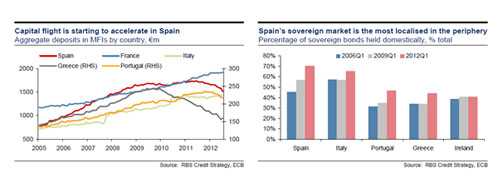
The fact that state bond auctions cannot even be absorbed by the underwriters is a big problem. We have been saying it for months. There is no relevant international institutional demand for government debt and auctions are gobbled between European central banks, local financial institutions and citizens, either through the Social Security or other public entities.

But … Why? If the Spanish budget was “very tough” and the government is doing the right thing, why does the market run in the opposite direction?.

First of all, it is worth highlighting a very important thing. The market does not want Spain to do badly. No way. Because Spain is not Greece. Spain is the 4th economy of the Eurozone and several times the size of Greece and as such it can not be “rescued”. If Spain falls, goodbye friends, nice to meet you. Say goodbye to the S&P 500, the Eurostoxx, Germany and the EU.

So if the market does not want Spain to fall and the budget is very conservative helping Spain to reduce the deficit … What’s the problem?

That neither the one nor the other. Investors of sovereign debt by definition are the most conservative investors in the market, and they are not convinced by the budget, either on the side of the revenues, which seem very optimistic, nor on the side of the expenses. On the revenues, the Spanish government expects to increase revenues in 2012 by 4.7% from the income tax (73 billion versus 69.8 in 2011). However, in the first two months of the year, revenues in this item have fallen 2.8%. Even in February, with the tax increase already in place, revenues from this item only grew by 1%. In an article, in Spanish, my friend Juan Carlos Barba points out the challenges of the budget and the differences of estimates, which could lead to a deficit that actually reaches 7% versus the target of 5.3% (Read here). The Laffer curve in all its glory. More taxes, less revenues. That is why I believe that the government has to be harder and more aggressive on expenditures, which is the lion share of the problem in Spain. They can.

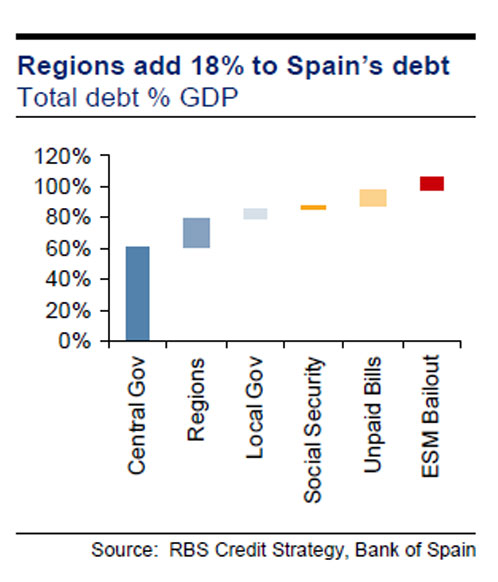
2012021796a1(chart above shows regional communities’ debt, which is not accounted as state debt)

The problem of the budget for investors is that it does not reduce the weight of the state in the economy, which is already way above 50%, the debt to GDP rises to 78%, which is almost 120% including private debt, autonomous regions and state-guaranteed debt, tariff deficit, unpaid bills etc. The total saving that the Spanish budget targets, 27 billion euro, is equivalent to the amount that Spain will spend on paying interests from the massive debt, not more. So, if the total debt continues to rise, budget cuts and tax increases only to pay interests the big elephant in the room, the big problem, is unsolved. An unsustainable and hypertrophied public sector and the massive burden of the regions, seventeen “small kingdoms” that have already increased their expenditures in the middle of “austerity measures” in 2011 by 10%, and will increase spending yet again in 2012. In some regions the public sector is larger than 55-60% of the region’s GDP, for example in Andalucia or Extremadura. This would all be fine if the expenditure had generated growth or jobs. But it has been the opposite. Money has been wasted in vast quantities and employment has plummeted. This is not austerity, it is keeping public spending orgy. Only a radical change on this point would improve Spain’s credit rating.

Investors make their numbers. Just a deviation in the estimated income of 3-5% down, could make the deficit skyrocket to between 8 and 10% above the government target.I assure you that markets have high hopes that this government, with absolute majority at the national level and in almost all regions, would be reducing total debt and the weight of the public spending, not to reduce its growth, cut subsidies and worthless megalomaniac expenditures and repay capital, stop capitalizing interests constantly. And the disappointment is greater when there is trust and hope placed but the government maintains the status quo. But they still have time to rectify. A hundred days are a hundred days.

Politicians are ignoring the effect of deleveraging of financial institutions on demand for sovereign bonds, not least because banks, their advisers, do not comment it. The Norwegian investment fund just reduced further their exposure to Europe. Not only governments have to do the right things, curtail political spending and encourage private job creation, which is the one that pays taxes, the public sector consumes taxes… States must take account that the pie of money available to invest in sovereign bonds continues to decline. And that makes what we consider “our rights”-unlimited access to debt, and cheap- unaffordable unless we change radically the structure of public spending.

The funds available for European debt have been reduced by an average of 20 billion euros a year every year since 2007, according to our own studies. Not only the cake has reduced, but competition is fierce, as no country has reduced its debt-issuing voracity. And of course, by increasing the money supply by 6% pa, we only have placebo effects. Because the increase in money supply is clearly inadequate compared with the increase of public and private indebtedness, but in addition it generates stagnation, deflation in the goods, products and services from our economy and much higher inflation in raw materials and imported foreign goods. In fact, most of the inflation generated in the EU between 2007 and 2011 is from commodities and foreign goods. The states are still in debt, but practically nothing of the additional money supply goes to the real economy, industries or households. It stays in zombie banks that purchase sovereign debt with ECB funds (paid by current and future citizens in taxes) and use the difference to keep zombie companies alive “until it stops raining.”

Of the 200 billion taken by the Spanish banks of the ECB all have been consumed in bond buying, cover the fall of deposits (-7.5% in 2011) and cover their own debt maturities, but neither the state’s nor private balance sheets have improved. Many investor are surprised at why very few companies and banks have taken the injection of Draghi liquidity and the “placebo effect – stock market euphoria” to raise capital and cut debt. Why? Better to be a zombie among zombies than victim of the greed of the of the hunger of the undead. Like Japan, but with a difference. A private and public debt that no one has reduced “because the recovery is coming.” UBS recently commented “the banking stresses are not yet addressed: We see the system as undercapitalised, poorly-funded and badly reserved …”.

No wonder that many companies do not generate free cash flow in the IBEX. Because when you generate it, it is seized by the governments in taxes. At least when the company generates no free cash flow it enters the list of “rescue-able”. And they keep as much income as possible in tax havens. I always say that there are no tax havens, there are tax hells.

But the problem is that Spain can not be rescued. The cost would exceed 500 billion euro and that cannot be afforded by the EU. Especially because as we talk about Spain, France is also close to the territory of danger, with a debt to GDP that will reach 100% soon.

A bond investor cannot accept just 5.9% for a 10-year bonds of a state+region apparatus that will swallow + 10% of expected revenues, because as we review the growth rates to more logical levels (-2 % in 2012 and -0.4% in 2013) the investor asks himself “where will the money come from?”.The Spanish institutions, constantly talking of acquired rights, seem to think that money is free and that we deserve it “at any cost”. It seems that public spending (political, not public) that is advocated so insistently by the political parties was not paid through taxes and borrowed money at an interest rate. And those who lend money have a nasty habit of expecting to receive that money back.

The investor asks only that expenses match revenues. Those who decide to cut essential services like education and healthcare but maintain more advisers than Obama, more official cars than the UK and France together, countless regional TV stations and zombie semi-state owned companies, 17 separate governments, regional embassies, grants and 5% of GDP in subsidies are those that we voted to manage these resources. All an investor asks is that resources be managed based on a reasonable income and based on the demand for bonds that the country can take. Spain can not be, even if it wanted, more than 30% of the European supply of bonds. And let’s see when we start implementing zero-based budgeting. Budgets that can only grow are a fallacy of “bull market”.There is, of course a solution. Curtail political spending and zero based budgeting. With courage. Adjust expenses to income.

Bill Gross, from PIMCO, said “Greece is a Zit, Portugal a Boil, but Spain is a Tumor”.Spain is the bridge between recession and the Euro recovery. Spain is much more important than we think. I am a Spanish citizen and I cannot believe that we can not reduce a bloated state. It’s time to raise awareness and decide where we go. History will not forgive us.Here is an excellent blog that details the Spanish debt evolution at regional and state level:

http://javiersevillano.es/BdEDeuda.htm#BCE

and the Economist:

http://www.economist.com/node/21551520

This from Ahorro Corporacion, one of the best Spanish brokers:

Spanish public debt sales by foreign investors (€53,538Mn since November) have been offset by the resident sector’s purchases, especially by domestic banks (€71,965Mn during the same period). However, the pace of public debt purchases by domestic banks (€25,000Mn/month) doesn’t appear sustainable over the long term (especially without expectations of additional ECB liquidity injections). As a result, the key factor for a sustainable decline in Spanish interest rates appears to be the recovery of foreign demand, which is only likely to occur if there are deeper structural reforms and the government meets public deficit targets.‬
Without any recovery of foreign demand we don’t foresee a sustainable downtrend in Spanish interest rates albeit the impact of carry trade deals and possible secondary market purchases by the ECB could help set a cap. Assuming a scenario without purchases of new Spanish debt issues by foreign investors in 2012e and renewal of only 50% of their Spanish debt positions which mature in 2012, the resident sector would need to purchase 100% of the Spanish Treasury’s net issues this year (€38,826Mn) plus maturities not renewed by the foreign sector of €24,635Mn (total Spanish public debt maturing in 2012 of €149,300Mn * 33% held by foreigners * 50% non-renewal hypothesis). In total, the resident sector would need to finance €61,461Mn, which we believe is possible given liquidity provided to domestic banks by the ECB’s two 3-year LTROs (Spanish banks received around €250,000Mn from the two LTROs, which should be used for: meeting banks’ 2012 debt maturities of €106,100Mn, meeting 2013 maturities of €79,900Mn, and purchasing public debt to take advantage of carry trade opportunities).‬

‪ More: ABC in Spain reports here that:

The cost of the public sector in Spain exceeds 200 billion euros a year . That’s the cost structure to hold the public sector in Spain as: central government, regional and local communities, municipalities, county councils and town councils and the long list of public companies, agencies and entities linked to them all. More than three million public employees from all levels of government and its agencies and public enterprises. In keeping with the extensive machinery of its public sector, Spain spends right now almost a quarter of its Gross Domestic Product (GDP). Just to pay the salaries of public employees, this year Spain will spend about 100 billion. The figure includes not only officials but also the long list of political appointees and consultants , temporary workers and contractors in the extensive network of public companies and agencies. The bulk of all that spending on salaries is for the autonomous communities, some 60 billion euros, with nearly two million workers on the payroll.

To watch my interview in Al Jazeera about the Spanish banking issues go: (Quicktime or Oplayer required) http://dl.dropbox.com/u/62659029/iv_daniel_lacalle_250512_0.mpg