Tag Archives: Energy

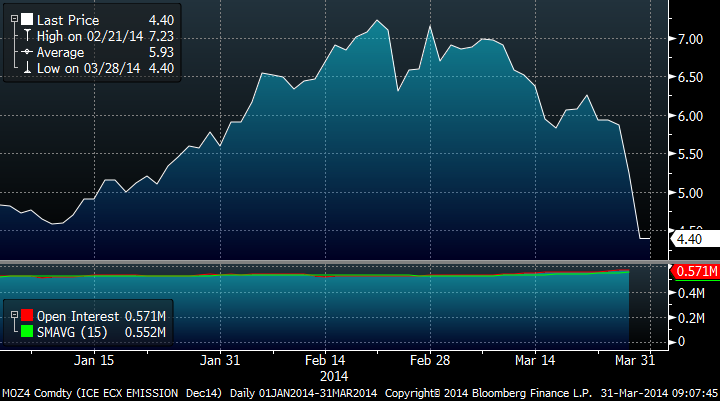
CO2 collapses 41% MTD

CO2 2014

CO2 continues to collapse (-41.8% MTD, -16% YTD) after the EU intervention has failed to address the massive oversupply of free credits  and demand continues to fall.  CO2 trades at €4.5/mt (31st March 2014). It traded as high as €35/mt in 2008. -87.7% from the peak, or a massive -30.7% per annum for a “politically designed” commodity created to desincentivize CO2 emissions.

Same story over and over: Oversupply meets falling demand:

–  Oversupply: The market reserve mechanism was introduced by the EU because even once CO2 backloading is applied, the oversupply of CO2 in the EU ETS will trough at around 1.5bn credits. The reserve mechanism will be used when the total number of allowances in circulation, defined for a single year as all the allowances and international credits issued from 2008 to that year, less the total emissions produced and any already in the reserve (basically the oversupply of the system) is above a certain level. This means that oversupply of emission rights in any given year will continue to be around 2bn tons of CO2 to 2020 in the most optimistic scenario. The supply of CO2 (EUAs) has exceeded demand by at least 20m Mtons almost every month since 2010. 

– Demand down: In the EU, 2013 verified emissions for the EU-ETS will be 3.8% lower yoy, and will reach 1.79bn tCO2, while ETS demand for 2014 is expected to fall another 3%. 

According to SocGen, CO2 emissions for the largest four sectors in the EU-ETS comprise nearly 95% of all emissions, historically. Combustion installations are by far the largest contributor, emitting over 70% of all CO2 in Europe. Verified emissions for combustion installations in 2012 were 11% lower than their 2007 peak, mirroring similar decreases in electricity consumption across Europe. Emissions from energy-intensive industries, like mineral oil refineries, pig iron/steel, and cement clinker/lime production have essentially stagnated since 2009, after a material drop coinciding with the beginning of the recession.

The European Union is 30% of the emissions of the world, but (hold on) 100% of the cost as no other country has adhered to emission trading schemes. Therefore, a slowdown in industrial production and a debt crisis that could delay the extremely aggressive and optimistic plans for a low carbon economy announced for 2030, added to the slow but sure slowdown in power demand is proving that a system that was artificially created is causing the demise of a government-forced scheme that ultimately was only a tax.

CO2 (as I mentioned in 2009) is a “fake commodity” artificially invented, where demand and supply are imposed by political entities… and it still does not work. Neither the Copenhagen, or Cancun summits, or the efforts of several investment banks and environmentalists have helped to raise the price. Interventionists were rubbing their hands at the prospect of increasing the price of CO2 through more than questionable environmental policies, and now they need to find inflation through imposition.

Unless we see a much more drastic approach from the EU to address the oversupply of EUAs the picture is not positive. But at the same time, a drastic approach attacks the economic recovery and adds a burden to industries all over Europe, so I would not count on it. According to Citi it would require a 14% increase in power and industrial demand to start to address the oversupply of EUAs.

In summary, lower industrial demand is driving emissions lower, and a miscalculated free rights scheme continues to show a massive oversupply.

See more at: https://www.dlacalle.com/why-co2-collapsed-20-in-two-days/

Further read: https://www.dlacalle.com/co2-collapses-to-all-time-low/


Energy Commodities see No Price Inflation from Ukraine-Crimea

Crisis? What Crisis? The Ukraine-Crimea conflict has to be the most uneventful geopolitical event solely judging by commodities price impact. Energy commodities are showing no price inflation from the Ukraine conflict as China slowdown is more relevant

Brent continues to shrug off any Crimea-Libya concerns and is down 0.8% MTD as the Chinese slowdown is vastly more important.

Russia is going to ship 88 cargoes of Urals crude from Primorsk, UST-Luga and Novorossiysk, highlighting there is no disruption to oil moves.

Spain could replace 10% of Russian gas exports to EU according to Platts. It would be achieved by boosting pipeline gas from Morocco and Algeria, fully utilizing its six regasification terminals to bring LNG and developing its own shale gas resources. However, the EU would pay 50% more if it replaced Russian gas with LNG, Norwegian gas and coal, and 80% more if it did so with renewables, according to Bloomberg and CERA.

China apparent oil demand in January-February fell 1.9% y-o-y, as the Chinese economy weakened. As a result of the shift of Chinese New Year from January in 2013 to February in 2014, apparent oil product demand fell -6.5% in January and rose 3.1% in February. In 2M14, inventory-adjusted demand slid 4.6% y-o-y.

According to Reuters, Libya’s national oil company said on Thursday that protesters had blocked the condensate pipeline linking the al-Wafa field to the Mellitah export complex. The gas pipeline is believed to be still operating. The protesters are reportedly threatening to stop exports from the Mellitah complex which is operated by ENI and NOC.

Coal is flat (-25bps MTD) at $80.50/mt. China announced a new plan to cut coal’s share of energy use to 65.0% in 20141, down from 65.7% in 2013, in a bid to improve air quality in major cities. With total energy consumption growth targeted at 3.2%, coal consumption would rise by just 1.6% this year while supply is expect to grow 3%.

CO2 is seeing another leg down, -28% MTD and moving close to flat on the year (+4.6% YTD), losing almost all the gains seen in the first months from backloading messages from the EU that do not address the chronic oversupply of more than 9 bn mt.

US gas is flat MTD at 4.6/mmbtu after Natural gas storage withdrawal was 57 Bcf. Natural gas storage is now at 896 Bcf, the lowest level since 2003. I expect there to be at least one more storage withdrawal (next week) before the injection season starts. Storage set to peak around 3,625 Bcf, which is approximately 225 Bcf below the 5-year average.

According to LNG World News, the Canadian government has authorised four proposed terminals on the country’s west coast to export LNG. The ministry of natural resources awarded the licences to Pacific Northwest LNG, Prince Rupert LNG, WCC LNG and Woodfibre LNG. Shipments from Canada’s British Columbia province can arrive in Asian ports in just 11 days, or nearly a month sooner than those from the US Gulf coast. All told, these long-term licences allow the four terminals to export up to 73.38m tonnes of LNG per year.

UK gas (NBP) continues to slide, down 8.8% MTD proving Ukraine is no real concern. European gas prices have not moved either, as inventories continue to be well above the 5 year average.

Power prices in Europe decline further: UK at 51.40£/mwh (-2% MTD), Germany at €34.55/mwh (-4% MTD) and Nordpool at €30/mwh (-2.9% MTD).

Commodities … Weakness despite Ukraine

Brent -0.6% MTD, WTI -1.1%. Brent-WTI spread +8.2% MTD. In the US, DOE data showed crude built 1.43 MMBbls vs. expectations for a 1.08 MMBbl build. Cushing crude inventories were down 2.67 MMBbls on the week and now stand at 32.1 MMBbls vs. approximate capacity of 66 MMBbls. Gasoline drew 1.60 MMBbls vs. expectations for a 0.88 MMBbl draw and distillates built 1.41 MMBbls vs. expectations for a 1.03 MMBbl draw. All products built 0.03 MMBbls. Refinery utilization was down 0.6% vs. expectations for a 0.3% decrease. Refinery utilization stands at 87.4% vs. a 5-year average of 82.4%. The 4-week average gasoline demand was down 0.9% YoY, and 4-week average distillate demand was up 1.0% YoY.
Japanese growth was revised down 30% to 0.7% in 4Q 2013. Aramco reduced Arab Light premium to Asia 20 cts/bbl, to $1.55 over average of Oman/Dubai grades; also cut Extra Light 20 cents, to $3.50/bbl; both had been expected to rise 15 cts. Shows how well supplied the market is. China’s overseas shipments declined by 18.1 percent in February from a year earlier, the biggest drop since August 2009, the General Administration of Customs reported on March 8. A median 7.5 percent increase was projected in a Bloomberg News survey of 45 economists.
Escalation of the conflict in Libya, as the country’s PM ordered an attack on a North Korean tanker which reportedly loaded $36m of crude from the rebel-controlled Es Sider terminal, if the tanker leaves the port. The rebels said any attack on the tanker would be interpreted as a declaration of war. Continue reading Commodities … Weakness despite Ukraine