Tag Archives: Macro

Myths and Mistakes of the Iraq crisis

This article was published in El Confidencial on 22/6/2014

“There is no military solution for Iraq” Barack Obama

“Rarely has a U.S. president been so wrong about so much at the expense of so many” Dick Cheney

Getting it wrong is dangerous. Worsening things is lethal. In the case of Iraq , the United States, after spending a billion dollars to remove the regime of Saddam Hussein, has left a global security problem which may be greater than imagined when Obama decided to withdraw the troops . It’s not just about oil. Anyone who lived the Baghdad of Saddam Hussein understood that the regime was a global danger. Similarly, it is essential to understand that the threat was not only Saddam, but the many factions that existed well before the Baath dictatorship, which remained in conflict during the regime and still do so today. Leaving Iraq can become a decision that Obama will regret for a long time.

Why did the U.S. leave Iraq? 

For love and peace? No. Because in 2016 the US will be energy independent -including Canada. The need to defend its interests in the area is today infinitely smaller.

America is already independent in gas and produces 11.3 million barrels a day of oil thanks to the fracking revolution, becoming the largest producer over Saudi Arabia and surpassing the country’s own 1970’s peak.

However, removing the troops leaving behind a timebomb of sunni and shiite factions could end up turning against the United States and the OECD, as it generates an enormous risk of multiple terrorist threats. Energy is not the problem. It is a cultural problem. It is naive to say the least to think that everything will go smoothly leaving Iraq on its own when the country is decimated by clashes of tribes with invasive ambitions. it is the same mistake we have seen in Libya or Egypt after removing a dictatorship regime. The Pandora box of multiple threats opens. I recommend you read ” The Clash of Civilizations “ by Samuel Huntington and “The Lesser Evil”  by Michael Ignatieff. In the West we do not want to understand the culture and customs of these countries, which are very far away from our idea of democracy. Accepting the lesser evil of maintaining a military presence is much more logical than closing our eyes in the hope that the world will move according to our wishes.

Does the Iraq crisis affect its oil exports?

The OECD placed too much trust on the unstable government of al-Maliki. US troops were disappearing and the industry seemed to be recovering. It looked as if everything was on track, but the risk had not gone away, in fact it had increased with the wrong strategic decision to pull U.S. troops from the country without a security contingent.

This week the Iraqi risk rose dramatically after terrorist attacks in the northern part from ISIS (Islamic State Of Iraq and Syria), a jihadist group that even has an annual report of its sinister achievements. See it here (http://azelin.files.wordpress.com/2014/04/al-binc481-magazine-1.pdf ) courtesy of the Financial Times .

When I traveled to Iraq people used to say: “Baghdad is a city covered in gold, but in the south is where the real gold is” (oil).

This map, courtesy of IHS Energy ( press@ihs.com ), shows the location of the main fields and refineries.

Terrorists have taken Mosul, the second largest city in Iraq, Tikrit, Tal Afar, and Dhiluiya Yathrib. However, they have not taken any of the large fields north of the country, especially the giant Kirkuk oil field in the Kurdistan region. the people I knew in the area called this field “the passport of Kurdish independence”. Today it produces 260,000 barrels a day. ISIS terrorists have no ability or desire to attack the Kurdish region.

Most of Iraq’s production, 80%, is exported and more than 77% comes from fields in the South, where terrorist ISIS militants cannot be measured with local forces and private security contingents. There has been no impact as of today in exports, which are made mostly through tankers from the South.

Is it a crisis to regain control of oil from the hands of the multinationals?

Contrary to what has been said in some press, oil in Iraq does not belong to international companies, much less American . All is state-owned fields where international, American, Russian, Italian, Chinese or British companies work with contracts for service , and they are paid to maintain or increase production. That is, the State benefits from international companies’ experience in improving productivity, and therefore has no interest in seeing these companies leaving. This type of productivity contract is what has led to Iraq recovering its pre-war peak production so quickly.

Is it all the fault of Obama or Bush?

The fights and attacks between Sunnis and Shiites are not new. It’s a conflict that has been ongoing for hundreds of years. In the era of Saddam Hussein it was already a challenge to organize security to travel from Baghdad to the border with Kurdistan. In fact, access was banned even for many potential contractors due to constant attacks.

George W. Bush made a mistake thinking that the US would be received as heroes after the invasion, as Wolfowitz expected. The moment that the regime’s repression ceased, the various factions began fighting bitterly. A weak government only reduced the perceived risk. The same mistake has been committed by the OECD in Libya and Egypt.

The Obama administration made a huge mistake by reducing up to three times the number of contingency troops that would support the weak government of al-Maliki. By reducing the promised figure of 50,000 soldiers to 25,000 and then to 3,000, aid became irrelevant, and therefore rejected by the local government.

The lack of involvement of NATO countries in the Middle East problem is part of the disaster. Not only Libya and Egypt have spiralled out of control, but Al-Assad in Syria is now more powerful than ever due to the inaction of the OECD, and Syria has become the launchpad of a strengthened ISIS in North Iraq. Thus, the risk that the area controlled by ISIS becomes a huge camp of international terrorists is not small.

Proposals to divide Iraq into three (Kurdistan, a Sunni North and a Shiite South) would increase the risk of allowing to build a huge training center for global jihadists.

Is the crisis due to peak oil?

Sunnis and Shiites have been fighting for hundreds of years. The problem is not oil … Because in the oil market there is no great risk.

On 11 June, OPEC met in Vienna. Independent analysis (BP Statistical Review) confirmed that there is plenty of oil for decades. Global proven oil reserves have increased to 1,687.9 billion barrels in 2013, sufficient to meet 53.3 years of global production.

Messages from the major oil exporters focused on some aspects that I think are extremely important when assessing the geopolitical risk and not overdo it:

  • The market is adequately supplied and OECD inventories in terms of demand cover are at “comfortable” levels (2,548 million barrels, 55 days, similar to the 55-60 day average level of the past ten years).
  • Spare capacity, ie what OPEC can produce above the established quota of 30 million barrels per day, is today 3.5 million barrels a day.
  • Iraq has reached a production of 3.3 million barrels a day, reaching record highs.

Will Iraq take oil to $ 200 a barrel?

Not likely. The OPEC spare capacity is equal to 100% of total production in Iraq.With the US producing at record levels and non-OPEC production growing by 1.2 million barrels a day in 2014, the market would be adequately supplied even if Iraq fails to export.

Libya, for example, has dropped to almost zero exports from one million barrels per day after the fall of Gaddafi and the oil price has not moved aggressively. The analysis is not “oil has risen to $ 115 per barrel,” but “even after the crisis in Libya, Ukraine and Iraq, oil has only risen to $115 per barrel …” And oil remains in backwardation (the future price is much lower than the spot).

Will the price of oil it create an economic crisis?

Oil does not create crisis. Excess credit and money supply that shoots commodity prices well above the fundamental levels are the ones that create crisis. The price of oil is a consequence, not a cause. In any case, the oil burden of the OECD has not reached 5.5% of GDP, far from levels that are supposed “to trigger a crisis”. The oversupply also helps to mitigate it.

The world has been operating with such crises in producing countries for decades. And the market is always adapting. But linking the Arab problem only with oil is a grave error on the part of all governments.

In the end, as Ignatieff said there is never an ideal solution. To think that the OECD will solve conflicts between Sunnis and Shiites that have been going on for centuries only with military domain is optimistic. Believing that NATO and the United States will be able to opt out of supporting Middle East security without dire consequences for the Western world is suicidal.

Important Disclaimer: All of Daniel Lacalle’s views expressed in his books and this blog are strictly personal and should not be taken as buy or sell recommendations.
Iraq and Ukraine move the commodities market

Geopolitical black swans are impacting commodities this morning, with Iraq conflict worsening and Russia threat of cutting supplies to Ukraine.

Brent is at $113.02/bbl and WTI at $107.32/bbl driven by concerns about Iraq. Markets are reacting well as the physical market is not affected so far but concerns are justified.

Iraq produces 3.5mbpd, or 4% of global production and is seen as a key source of future supply growth. Production is mostly in the fields in the South, so far unaffected by the latest attacks, concentrated in the North, according to JP Morgan.

So far the physical market has not seen a relevant disruption, but markets will remain nervous as long as Malaki continues to lose the grip of the key cities, and the terrorists get close to Baghdad.  Expect oil to move closer to $115/bbl Brent as the market analyses the risk of losing exportable production.

The Islamic State in Iraq and the Levant (ISIL) have seized the city of Tal Afar in Northwestern Iraq yesterday but have not continued to advance to Baghdad, so far only concentrating on northern Iraq. The rebels have control of Mosul, the second largest city in Iraq, along with Tikrit and the small towns of Dhiluiya and Yathrib, north of Baghdad. Iraq’s military spokesman Qassim Ata yesterday said that the Iraq army had killed more than 279 members of the rebel group. President Obama has indicated that he is reviewing military options to help Iraq in fighting the rebel groups.

Kurdistan PM is mentioning in the BBC the possibility of splitting Iraq into three separate regions.

The Kurdistan Regional Government has taken over security of the giant Kirkuk field (260k b/d of production) in the North Remaining oil production in the northern oil fields is another 435k b/d. Iraq has the 5th largest proven oil reserves & is the 2nd largest crude producer in OPEC, behind Saudi Arabia, at 3.5 mbpd. OECD oil inventories were 2,624mb at end April, 77mb lower than the 5-yr average & 53mb lower than last year.

My thoughts:

– The US is unable to get involved in a war. The fact that the US will likely be oil independent (including Canada) in 2016 gives little incentive to take action.

– There is very little real western support for Malaki and the country is currently too corrupt so there is risk of a bad public image and lack of popular support problem.

– Oil companies in the South have very strong armies and security is very tight. I see low risk of oil supply disruptions and the ports are working adequately.

– The three large oil companies must have anticipated these issues as they shipped most of their needed equipment last year. They also doubled security.

– Low probability of the ISIS reaching Baghdad but strong probability of a country that ends up broken in three (Kurdistan, a Sunni North capital Tikrit and a Shiia South capital Baghdad).

Helping reduce the geopolitical risk on oil is the FT reporting that US liquids production hit 11.27 mbpd in April, and is today above its previous peak in 1970 of 11.3 mbpd. With a higher percentage of NGLs, still crude production was 8.3 mbpd in April (now 8.5m), lower than the record high of 10 mbpd in November 1970.

UK gas rises +7.1% at 45p/therm and European gas seems to rise in sympathy as Gazprom threatens to cut supply to Ukraine after the deadline to pay the outstanding bill of $2bn passed with no agreement on  a timetable of payment or price. The Ukraine government is mentioning that the price has to be revised to international levels and that they cannot pay this figure or the revised price of $8.5/mmbtu. The EU is looking for an option that includes a revision of the price for a long term contract and gradual payments. Gazprom will cut off supplies unless Ukraine pays for the gas up front.

Gazprom however, will not disrupt supplies to Europe. 33% of Europe’s gas comes from Gazprom and 50% of it is transported through Ukraine. Ukraine has enough gas in storage (13bcm) to hold on to summer demand as its annual consumption is 33bcm according to UBS. Europe also has a record amount of gas in storage after a very warm winter.

Europe’s largest gas supplier after Gazprom is Statoil who mentions it can “easily” offset any short-term disruption of Russian supply.

 Coal remains weak at $80.40/mt holding on to its support level despite news that freight rates for panamax dry bulk vessels are now below opex, and long-term forward rates have fallen below break-even. Chinese coal import is the most important trade for panamaxes and chinese imports of thermal coal are expected to be lower in 2014 than in 2013. Capesize rates have come down 43% YTD and forward rates for Q4 fell 4% this Friday.Adding to this a 100 milion tonnes of Australian capacity growth, the outlook for both coal prices and the Baltic Dry is not positive. Freight companies are growing the fleet by 4% this year so oversupply is even higher.

The Baltic Dry index is down 3% this month (-60% YTD) driven by oversupply of reights and weakening Chinese imports.

 CO2 rises 53bps at €5.74/mt helped by backloading efforts to reduce the impact on CO2 prices of lower industrial demand and poor thermal output.

US gas rises 65bps at $4.67/mmbtu helped by the past six weeks injection data. It would require a very aggressive change in injection data in the next months to justify prices below $4/mmbtu… I believe we are going to see $5/mmbtu sooner rather than later. Weekly natural gas storage injection of 107 Bcf way below the consensus median injection estimate of 112 Bcf and the bears’ view of 161bcf. Total working storage is now at 1,606 Bcf, 727 Bcf below last year’s level and 877 Bcf below the 5-year average of 2,483 Bcf.

Power prices in Europe are reacting mildly… Germany at €34.70/mwh (-5.35% YTD), Nordpool at €30.78/mwh (-4% YTD). Spanish power prices are down 1.2% YTD and French -5.5% YTD.


Important Disclaimer: All of Daniel Lacalle’s views expressed in his books and this blog are strictly personal and should not be taken as buy or sell recommendations

The Difficulties of Implementing QE in Europe (CNBC Interview)

Interview at CNBC where I discuss:

The difficulties to implement Quantitative Easing in Europe.

The difficulties to implement Quantitative Easing in Europe come from the increased perception at the ECB and the EBA that a €1 trillion program could distort markets too much as in some cases the ECB would take 100% of supply.

. There is no liquidity issue: To start with, Europe already has more than €180 billion of excess liquidity according to the ECB March report.

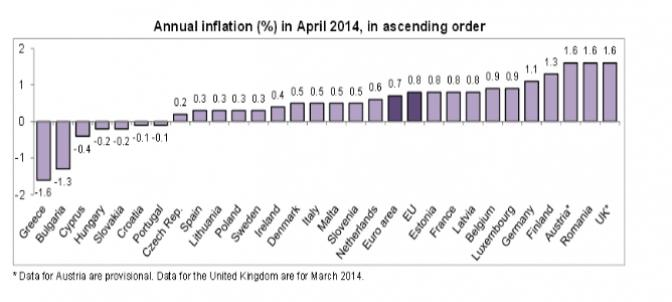
. There is no deflation: Inflation at the Eurozone in April was 0.7% while EU was 0.8%. This is within the ECB mandate of “at or below 2% in the medium term”. CPI in April was 0.4% in Spain, and only Greece (-1.6%) and Bulgaria (-1.3%) show worrying signs.

inflacion eurozona abril 2014

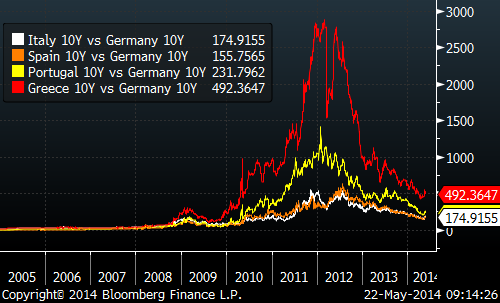
. Bond yields are at historical lows. Bond yields in the periphery have fallen to the lowest level since 2005. Portugal and Greece are out of the bailout program and issuing paper.

eu bond yields


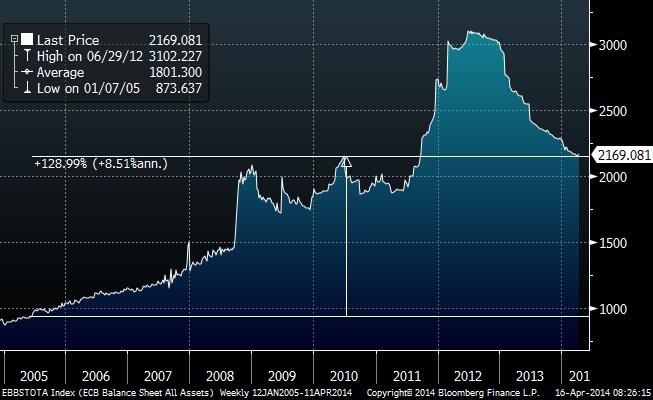
. ECB balance sheet is still elevated. At €2.2 trillion (2.5% capitalization) its balance sheet has fallen 20% since the peak but it’s still up 128% since 2005. The Fed balance sheet is $4.1 trillion (ECB 3.1 trillion translated in US$).

ECB-Balance-Sheet-2014

. Transmission mechanism to SMEs is improving. Lending to SMEs is up 34% in the periphery since March 2013.

Growth is improving (+1.4% in 2014) and the strong euro has not affected dramatically export growth all over the periphery. Current account deficits have arisen in Spain for example. The biggest issue the ECB faces is that 60% of EU exports are made within Eurozone countries, therefore currency is irrelevant. The second is that with current account deficits widening, imports would suffer a big increase in price, particularly energy components. This worries the ECB more than anything else.

However, all of the ECB is studying options of QE driven mostly to help boost the next leg of growth. “Of course any private or public assets that we might buy would have to meet certain quality standards,” said Jens Weidmann, in an interview with MNI.

. What to spend the QE money on?

The European ABS market is too small (€300bn-450bn) for a €1 trillion QE and the challenges would be high when buying sovereign debt in order to adhere to the mandate.

There are three options for the ECB: yield curves, regional differences and credit spreads, which would be targeted in the ECB’s version of unconventional monetary policies. Some of the measures are more akin to Credit Easing (CE) than Quantitative Easing (QE). It is

also apparent that the approach is more qualitative because if the ECB is to make purchases it will take into account valuations.

The ECB would choose from different options, which reflects the bank-based intermediation that dominates in the Eurozone, unlike in the US where the main focus of QE has been Treasuries and MBS. As a possibility, the ECB could choose a normalisation of haircuts on its collateral.

There is also the issue of the “no deflation yet” debate. The Bundesbank is worried about a CPI that reflects massive disparities and that a QE would bring higher inflation to small consumers and average medium income families. The ECB needs more time to see if there is really a price deflation issue. So far data suggests otherwise. No deflation, just disinflation due to overcapacity and previous bubbles.

Look at March CPI in most countries, but particularly in Spain considered at the highest risk of “deflation” by the IMF. Look at essential goods like fish (+3,2%), milk (+4,4%), fruit (+6,5%), legumbres (+3,2%), cheese (+2,2%), natural gas (+2,3%), electricity (+6%) education (+3,5%), insurance (+4,1%) water (+3,3%), or even tobacco (+3,4%), alcohol (+2,4%) or travel (+4,4%).


When you have invested (spent) hundreds of billions of euros in “industrial plans” and productive capacity, especially in energy, car industry, textile, retail and infrastructure, what we are experiencing is a reduction of prices due to competition between oversized sectors, an overcapacity of up to 40% in some cases. On the other hand, inflation exists in other elements, very relevant to the industry and consumption, such as energy costs.

The “alleged risk of deflation” is the excuse of governments to justify greater financial repression . Trying to create false inflation through rate cuts while citizens have less purchasing power, or through monetary stimulus plans when taxes rise leads nowhere. Look at Japan, 17 consecutive months of real wage reductions.

PRICES FALL BECAUSE WE BUILT MASSIVE PRODUCTIVE CAPACITY FOR A DEMAND THAT NEVER ARRIVED AND BECAUSE THE DISPOSABLE INCOME OF CITIZENS HAS BEEN DESTROYED BY CONFISCATORY TAXATION.

To reactivate the economy governments should return money to the pockets of citizens who have stoically accepted and paid interventionist policies and supported schemes and incentives that have led the EU to spend up to 3% of GDP to destroy 4.5 million jobs and sink the economy.

 The ECB is getting a lot of pressure to do something from governments and banks, and now even Germany seems to accept the high EUR is a danger… and if something is done it will have to be something big. But these issues above do matter –specially for the Germans advocating for internal devaluation exits to the crisis- and the risks are not small of causing massive distortions in an already booming market for high yield bonds and sovereigns.


 See more at: https://www.dlacalle.com/deflation-no-disinflation-the-consequence-of-interventionism/#sthash.Isz8PWji.dpuf


Important Disclaimer: All of Daniel Lacalle’s views expressed in his books and this blog are strictly personal and should not be taken as buy or sell recommendations

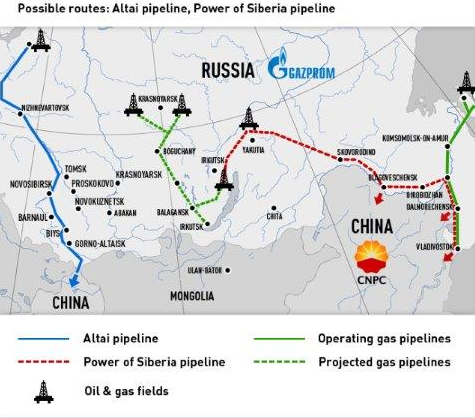
Gazprom-CNPC deal

Gazprom dealMap courtesy of Gazprom

Conditions:

30 year agreement to start in 2018

38bcm of Russian gas to be delivered to China annually (25% of Chinese demand)

Price: Estimated $350-400/mcm. The formula pricing (oil and a basket of oil products)

Capital Expenditure: $75bn (China’s share $20bn) – includes development of Chayanda and Kovykta fields; and construction of a 2,500-mile pipeline, a petrochemicals complex and a helium plant

Prepayment: $25bn (yet to be confirmed)

The estimated price of the Russia-China contract is $9.75/mmbtu (only $0.95/mmbtu higher than long term Europe contracts). This means that E.On, RWE and GSZ will find it difficult to lower their gas price-offtake agreements in the negotiations of their contracts with Gazprom.

The two sides were not actually negotiating a specific price per unit of gas, but rather a ratio of gas to oil prices. The numbers above likely assume prevailing oil prices, and actual realized prices over the course of the contract could vary significantly depending upon oil markets (according to Citi).

The contract signed targets a nominal volume of 38bcm. However, volumes could be expanded to 60bcmpa later on

Citi estimate the IRR of the project at 4.4% on an ungeared basis and 4.8% assuming 50% project gearing, lower than either Gazprom or Petrochina’s cost of capital, thus generating a negative NPV.

Important Disclaimer: All of Daniel Lacalle’s views expressed in his books and this blog are strictly personal and should not be taken as buy or sell recommendations