All posts by Daniel Lacalle

About Daniel Lacalle

Daniel Lacalle (Madrid, 1967). PhD Economist and Fund Manager. Author of bestsellers "Life In The Financial Markets" and "The Energy World Is Flat" as well as "Escape From the Central Bank Trap". Daniel Lacalle (Madrid, 1967). PhD Economist and Fund Manager. Frequent collaborator with CNBC, Bloomberg, CNN, Hedgeye, Epoch Times, Mises Institute, BBN Times, Wall Street Journal, El Español, A3 Media and 13TV. Holds the CIIA (Certified International Investment Analyst) and masters in Economic Investigation and IESE.

Interview On New Spanish Unemployment Data & Spanish Energy Sector

Listen here:

http://www.thespainreport.com/5960/interview-daniel-lacalle-new-spanish-unemployment-data-spanish-energy-sector/

(The following was published in El Confidencial on 29/4/2014)

On Tuesday,   the Spanish Labour Force Survey or the first quarter of 2014 was published. The official release of the Statistical Bureau (INE) states that “the total number of unemployed has fallen by 344,900 people in a year.”

The number of unemployed decreased by 2,300 people in the quarter and stands at 5,933,300.

Unfortunately, the job participation fell by 184,600 people, although the decline is the lowest in a first quarter since 2008 .

The few positive data show fragility and weakness . These are insufficient. Taxes have to be cut. Political spending needs to be cut. The country needs to stop hindering job creation.


Labour participation fell by 195,800 people in the private sector, and increased by 11,100 and the public sector. Increasing public employment with more debt is not creating jobs.  It enlarges the hole .

Taxes have to be cut. The fiscal effort in Spain remains one of the highest in the OECD. And it’s not a race to raise revenues, as I explained in the post ” Spending is the problem . ” The policy of sustaining GDP  with bloated spending  does not reduce unemployment. It’s urgent to cut taxes.

Spain has the potential to create millions of net jobs. It is expected that the country will create 650,000 new jobs between 2014 and 2015 – (I estimate about 800000 to 2016) – but it’s not enough.

Jobs will not come from a hypertrophied Administration that consumes nearly 45% of the country’s resources and where spending on public employment represents 11.9% of GDP, higher than the average of all the developed countries, which stands at 11.3%. Not to mention advisors (one billion euro per year) or employees of public companies.

Jobs are not going to come from large companies that already have an average of 20% more employees than its European peers (employees relative to turnover in the country, according to Bloomberg). Jobs will come from self-employment and SMEs.

To reduce unemployment Spain must:

–  Encourage self-employment . Create businesses in 24 hours, as in many countries, not being one of the OECD countries where it is more expensive and slower to start a company. The time required to start a business in Spain is twice the average of the OECD. Creators of small businesses and startups can not see that the cost is unaffordable relative to the risk assumed.

–  Encourage SMEs.  We should not forget that they are the ones that create 70% of the added value of the country. Lower corporate taxes and Social Contributions to create jobs. The Spanish companies spend a total of 58.6% of their profits to pay taxes, according to World Bank data.

–  Reduce self-employed fees.  Self employed tax contributions have increased by 20%. This has to change now.

–  Reduce taxes on businesses.  New companies should not pay social security contributions and taxes until they have two years of profits, as in the UK. And drastically curtail bureaucratic obstacles and the extreme complexity of a country’s legislative system with seventeen regimes creating hundreds of rules each year. Change incentives: less foremen to “stop and control” and more facilitators.

–  Reduce income tax to increase consumption.  Yes. Save.Without savings, and later with consumption, the economy does not kickstart. Discouraging savings to keep an inflated GDP is a wrong and dangerous policy. The gross salary of a worker deducts 47.3% in taxes. Adding VAT, 67.4% of an average salary goes to the state.

–  Cut political and superfluous spending, subsidies and bubble excesses , as I said in this  post . Spain has increased government spending by 48% between 2004 and 2009 and only slightly reduced by 5% since 2010.

The solutions will not come from the same wasteful policies and interventionism that destroyed 3,000,000 jobs.

The Official Survey data shows the obvious: Not enough jobs are being created with a hypertrophied state.  Data shows recovery but it is fragile and insufficient.  Much more can be done.

We must lower taxes, and now.


Important Disclaimer: All of Daniel Lacalle’s views expressed in his books and this blog are strictly personal and should not be taken as buy or sell recommendations
CO2 … recovery or dead cat bounce?

CO2 recovery

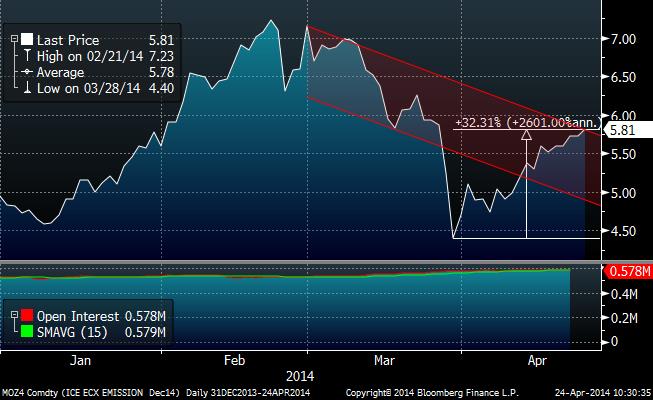
Carbon has seen a decent bounce after the collapse back to €5.80/mt (albeit nowhere close to the highs of €20/mt seen a few years ago). Carbon is trying to climb back after the recent sharp correction. I commented a few reasons for the fall in prices here.  Now to the recovery…

What is driving prices higher?

. Kickstart of the carbon backloading plan, which sets aside 900m carbon certificates on a temporary basis. Backloading is implemented in 2Q 2014 after a 3-month scrutiny period and lasts until 2016. However, the 900 m certificates will be re-injected in 2019-20 again, so the oversupply is not addressed unless we see massive increase in thermal demand, which is unlikely given oversupply in generation and renewables rollout. As UBS points out “9GW of new efficient coal plants with marginal cost not higher than €30/MWh will enter the system by 2015, with a negative effect on dark spreads. In combination with declining power demand and renewables capacity growth (5 GW), we see little reason for a bullish view on generators”.

Market is very oversupplied, but the implementation of backloading has already started. So what we are seeing is a liquidity driven squeeze, not a fundamental shift in supply-demand. The most optimistic scenarios from analyst estimates see oversupply lasting until 2030 (UBS sees 2032).

Oversupply of EUAs has gone from 500 million metric tonnes in 2010 to 900 million metric tonnes in 2014 and despite backloading it is expected to double by 2020.

Mr Bostjan Bandelj a director at Belektron in Ljubljana said on Reuters that “Even as backloading seems a done deal, prices are under pressure from government auctions and sales of allowances from a special reserve by the European Investment Bank in the next months.”


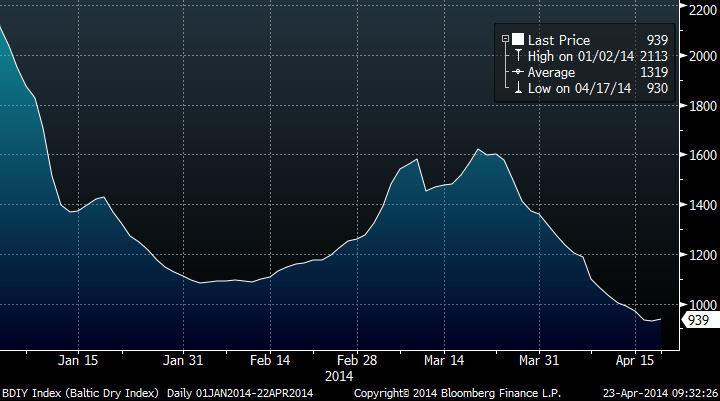
Baltic dry Index falls 58% YTD

BDI April


I mentioned it here. The Baltic Dry is showing that global trade is not improving while the fleet continues to grow.

It’s the same old scene… as Roxy Music would say. Too much supply, too little demand.

. Fleet growth +6-7% in 2014 and 4-5% in 2015. Roughly 16M DWT (dead weigh tonnage) of capacity was delivered in the first quarter of 2014 (annualized growth of 8%). A huge number not absorbed by demand.

. Spot  rates in the 6 major global routes have averaged $10kpd YTD, down $4-5kpd from last year’s levels.

Demand slowdown:

. Reported chartering data have been relatively flat compared to last year. Chartering has grown less than 1% pa in the past two years while fleet grwoth has exceeded 2.5% pa.

Capesize rates continue their free fall. Despite a solid number of new charters to China, mostly from Australia, spot Capesize rates are now at $9kpd (-64% MTD).  Brazilian activity is still low and Chinese steel demand remains poor despite stockpiles of flat and construction steel products falling, now -15% YoY.

Some positive support short term:

China continues to show strong demand for iron ore imports. Credit Suisse counted 27 iron ore fixtures last week, which is up 20% over the trailing two month average.

… But overcapacity is not addressed

The overall picture for the next two years is a moderation in the overcapacity increase, not an imprvement in the supply-demand balance. It is hard to see dayrates improving dramatically in such a scenario even if global chartering increases 5%.

Commodities Update

Now Ukraine is making a real impact on commodities. UK gas is up 4.2% MTD. Europe has three months of gas demand covered in case of disruption and 65 days of demand in oil inventories, according to ENI CEO.

Brent is up 0.6% MTD at $107.28/bbl, while WTI is up 2.75% at $103.48/bbl. The geopolitcal risk has cranked up with the Kiev government giving Russian separatists until this morning to disarm & leave public offices while there continue to be reports of a large Russian troop presence on the Ukraine border. Libya’s western export terminal Zawiya has re-opened after being vacated by protesters. CFTC data released on Friday saw money manager long positions in futures & options for the week to 8 April rise by 24,310 to 380,000 contracts. North Dakota oil production averaged 951k b/d in February, +16k b/d from Jan & +170k b/d y/y.

Coal is up 49bps at $81.30/mt. Indonesian thermal coal exports dropped to 32mt in January, the lowest level in 5 months and down 9% YoY, according to official customs data. Steel inventory continues to be drawn down rapidly in China, with reported stocks held by traders falling 3.9% over the last week. Trader stocks are now 15% lower than a year ago. Inventory of rebar on the Shanghai Futures exchange also dropped sharply, falling by nearly 240kt to 2.5mt, the lowest level since the rebar contract started trading in June 2009.

CO2 is up 15% at €5.39/mt driven by higher coal and gas utilization in Europe on security of supply measures and expectations of EU backloading to withdraw 9m tonnes of oversupply.

US gas is up 5% at $4.65/mmbtu as the weather trade slowly unwinds after inventories rose 4 Bcf, below consensus expectations of a 15 Bcf injection. However, strength is derived from the fact that inventories are now 826 Bcf, widening the deficit vs the 5-yr avg to 994 Bcf.

UK gas opens is up 4.2% at 53.20p/th driven by the Ukraine dispute and Gazprom threatening to cut supplies to Ukraine. Inventories are still above 4,000 mcm.

Power prices reacted positively to gas spike. UK power is up 40bps at 50.40£/mwh, German power is up 58bps at €34.55/mwh and Nordpool up 0.16% at €29.65/mwh.